
PARISH OF CHRIST THE KING & MARQUETTE CATHOLIC SCHOOL
EMERGENCY ACTION PLAN (EAP)
Prepared by: Director of Operations and Strategy (Chris Davenport)
Under the Supervision of: Pastor (Fr. Elkin González)
Updated: May 7, 2026
Compliance: OSHA 1910.38 | NFPA 101 | FEMA CPG 101 | Diocese of Tulsa EAP | DOE Standards
TABLE OF CONTENTS
1.0 Introduction and Authority
1.1 Purpose
1.2 Scope
1.3 Policy Reference
1.4 Responsibility and Oversight
2.0 Communication and Notification
2.1 Chain of Command
2.2 Internal Notification
2.3 External Notification (Police, Fire, Diocese)
2.4 Media and Parent Communication
3.0 Evacuation Procedures
3.1 Evacuation Signals
3.2 Designated Routes and Rally Points
3.3 Student Accountability and Reunification
4.0 Intruder / Lockdown (Code Blue)
4.1 Definitions and Response Phases
4.2 Staff Roles and Expectations
4.3 Recovery and All Clear
5.0 Bomb / Explosive Threat
5.1 Threat Handling Procedures
5.2 Search and Notification
5.3 Evacuation and Re-entry
6.0 Fire Safety and Evacuation (Code Red)
6.1 Fire Alarm and Suppression Equipment
6.2 Evacuation Routes and Procedures
6.3 Coordination with Tulsa Fire Department
7.0 Tornado and Severe Weather (Code Yellow)
7.1 Shelter Locations
7.2 Safety Procedures
7.3 All Clear and Dismissal
8.0 Medical Emergency and First Aid
8.1 First Aid Procedures
8.2 Incident Documentation
8.3 Post-Emergency Review
9.0 Training, Drills, and Documentation
9.1 Required Drills (ECDC and Marquette)
9.2 Training Requirements
9.3 Recordkeeping and Annual Review
10.0 Recovery, Restoration, and Post-Incident Actions
10.1 Reunification of Students
10.2 Facility Re-entry and Damage Assessment
10.3 Counseling and Communication
11.0 Signature and Approval Page
Appendices
Appendix 1 – Emergency Drill Evaluation Form
Appendix 2 – Student Accountability and Reunification Form
Appendix 3 – Emergency Contact Quick Reference Poster
Appendix 4 – Emergency Command Chart
Appendix 5 – Parent Communication Scripts and Templates
Appendix 6 – Post-Incident Recovery and Counseling Plan
PLAN
It is the intent of the Parish of Christ the King and Marquette Catholic School to fully comply with all applicable emergency regulations and to protect our students, staff, parishioners, and visitors in the event of an emergency.
This Emergency Action Plan (EAP) adheres to the Health & Safety Program of the Diocese of Tulsa and has been developed in accordance with:
Regulatory & Planning Standards
OSHA 29 CFR 1910.38 — Emergency Action Plans
NFPA 101 — Life Safety Code
FEMA CPG 101 — Developing Emergency Operations Plans
Diocese of Tulsa & Eastern Oklahoma — Policy Library (EAP Template)
Threat-Specific Resource Hubs
CISA — Bomb Threats Resource Hub
CISA — What to Do: Bomb Threats (PDF)
DHS TRIPwire — Bomb Threat Checklist (PDF)
Oklahoma State Guidance
OK Homeland Security — Developing School Emergency Operations Plans (PDF)
OK Emergency Management — State Emergency Operations Plan (EOP) (PDF)
REMS TA Center — School Safety & EOP Toolbox
Tulsa and Surrounding Weather Resource
Use these sources for current alerts, warning definitions, school emergency operations planning, reunification, and official preparedness guidance. Printed copies should be reviewed at least annually and after any policy or site change.
NWS Tulsa forecast office: https://www.weather.gov/tsa/
NWS Tulsa active hazards: https://www.weather.gov/tsa/hazards
NWS Tulsa NOAA Weather Radio: https://www.weather.gov/tsa/weather_radio
NOAA Weather Radio overview: https://www.weather.gov/nwr
City of Tulsa severe weather safety: https://www.cityoftulsa.org/residents/public-safety/weather/
City of Tulsa emergency sirens: https://www.cityoftulsa.org/residents/public-safety/emergency-sirens/
City of Tulsa flood safety: https://www.cityoftulsa.org/government/departments/water-and-sewer/flood-control/flood-safety/
Tulsa County Emergency Management: https://www2.tulsacounty.org/community/tulsa-county-emergency-management/
Ready.gov alerts: https://www.ready.gov/alerts
Oklahoma OEM alert guidance: https://oklahoma.gov/oem/news/newsroom/12-ways-to-prepare--practice-emergency-drills-112.html
U.S. Department of Education REMS TA Center: https://rems.ed.gov/
K-12 School EOP Guide - U.S. Department of Education: https://rems.ed.gov/docs/REMS_K-12_Guide_508.pdf
SchoolSafety.gov Standard Reunification Method: https://www.schoolsafety.gov/resource/standard-reunification-method-volume-2
The plan is designed to remain consistent with the policies and procedures established by the Diocese of Tulsa (“Diocese”) and has been reviewed by the Diocese of Tulsa Emergency Response Team (ERT) to ensure compliance with diocesan health, safety, and preparedness standards.
This document provides detailed guidance for responding to emergencies such as fire, medical incidents, intruders, severe weather, and other critical events.
Disclaimer
Emergency Action Plans (EAPs) represent reasonable efforts to implement best practices in emergency preparedness. No plan can anticipate every circumstance or variable. All personnel are expected to exercise sound judgment, remain situationally aware, and act in accordance with the conditions and information available at the time of an emergency.
Introduction
The Parish of Christ the King and Marquette Catholic School recognize the sacred duty to protect the life and dignity of every person entrusted to their care. Human life is a gift from God that must be respected, safeguarded, and nurtured in every circumstance.
This Emergency Action Plan (EAP) provides a unified framework for responding to emergencies that may affect parish and school operations. It outlines clear procedures to protect the well-being of students, faculty, staff, parishioners, and visitors during any emergency.
The plan integrates diocesan policies with applicable state and federal regulations to ensure consistent preparedness, timely response, and organized recovery following an incident.
This document applies to all parish and school personnel and is supported by ongoing training and safety exercises to ensure operational readiness. Response procedures, contact directories, and reporting forms are in the appendices.
The Church teaches that “human life is sacred because from its beginning it involves the creative action of God, and it remains forever in a special relationship with the Creator who is its sole end. God alone is the Lord of life from its beginning until its end.” Life is a precious gift from God. It is a gift that must be respected, honored, and protected. The dignity of human persons is rooted in their creation in the image and likeness of God.
Human life is sacred and must be protected.
This Emergency Action Plan (EAP) was created to ensure the safety of all students, parishioners, staff, and visitors of Christ the King Parish and Marquette Catholic School. It includes planned responses to fire, weather emergencies, medical incidents, and intruder situations, in accordance with the Diocesan Emergency Action Plan.
All employees are responsible for carrying out this plan and will be fully trained in it. This EAP is designed as a resource tool that will determine what appropriate steps should be taken in an emergency and what will meet all applicable local, state, and federal regulations. Response activities associated with specific threats and hazards are identified in the Appendix.
EAP Coordinator
The Director of Operations (Chris Davenport), under the supervision of the Pastor (Fr. Elkin González), is responsible for making sure this emergency action plan is kept up to date with practices and is reviewed periodically.
The Emergency Plan Coordinator can be reached at 918-340-0010 or cdavenport@ctktulsa.org
Chancery EAP Coordinator
The Diocesan Director of Loss Prevention (Donna Eurich), under the supervision of the Chancellor (Deacon Harrison Garlick), is responsible for making sure this emergency action plan is kept up to date with practices and is reviewed periodically.
The Emergency Plan Coordinator can be reached at 918.307.4919 or donna.eurich@dioceseoftulsa.org
Facility Codes and Operation
| Code | Facility | Description |
| ECDC | Early Childhood Development | For ages 3 years old to Pre-K |
| MARQ | Marquette | For K-8 educational facilities |
| CTKC | Christ the King Church | Parish church facilities |
| CTKP | Christ the King Parish Office | Parish administrative offices |
| CTKB | CTK Boiler Room | Youth Gather Basement below Sanctuary |
| FLSH | Fletcher Hall SHEC | Parish hall for community events |
| ROTH | Rother House | Separate house for gatherings |
| FOCS | 1515 S. Rockford Ave | Focus Mission House |
Purpose
• Protect life and minimize injury during emergencies.
• Provide clear communication and coordination among parish and school personnel.
• Establish procedures for evacuation, lockdown, sheltering, and recovery.
• Ensure compliance with the diocesan, state, and federal safety standards.
Scope
This plan covers emergencies including, but not limited to:
• Fire or explosion
• Medical emergencies
• Intruder or violent incident
• Severe weather or natural disasters
• Bomb or suspicious package threats
• Structural or utility failures
All staff and volunteers are responsible for understanding and following the procedures contained within this plan.
Definitions
| Term | Definition |
| EAP (Emergency Action Plan) | The written procedure established to ensure orderly and efficient evacuation, shelter, or response actions during an emergency. |
| Building Lead | An employee of the Chancery, a member of the ERT, Paster, Building Lead, EAP Coordinator, is designated to assist in the evacuation and accounting of personnel during an emergency. |
| ERT (Emergency Response Team) | Parish and school personnel assigned to coordinate emergency procedures, drills, and liaison activities with first responders. |
| Emergency Action Coordinator | The principal or Director of Operations acting as the on-site authority during an emergency, responsible for decision-making and coordination with civil authorities. |
| Threat | A natural or manmade occurrence, individual, entity, or action that has or indicates the potential to harm life, information, operations, the environment, and/or property. |
| Vulnerability | Characteristics of the Chancery that could make it more susceptible to the identified threats and hazards. |
| All Clear | The formal signal issued by the Incident Commander or responding authority indicates that the emergency has ended, and normal operations may resume. |
| Evacuation Route | The predetermined and clearly marked pathway to be used during an evacuation. Routes are posted in every classroom and parish facility. |
| Reunification Area | The designated safe area where students and families are reconnected following evacuation or lockdown procedures. |
| Drill | A planned exercise designed to practice emergency procedures under controlled conditions. |
| Critical Incident | An occurrence, caused by either human action or natural phenomena, that may bring about harm and may require action. Incidents can include major disasters, emergencies, terrorist attacks or threats, hostile events, fires, floods, hazardous materials accidents, tornadoes, public health and medical emergencies, and other occurrences requiring an emergency response. |
| All-Call System | The intercom or phone-based system used to communicate alerts to all parish and school areas simultaneously. |
Communication & Notification
EAP Leader-Schedule
EAP School Hours 7:00am-5:30PM while school In-Session
EAP Mass and Other Onsite Events-Pastor
Ministry Events
EAP Coordinator
Director of Operations
The Director of Operations (Chris Davenport), under the supervision of the Pastor (Fr. Elkin González is responsible for making sure this emergency action plan is kept up to date with practices and is reviewed periodically.
The Emergency Plan Coordinator can be reached at 918-340-0010 or cdavenport@ctktulsa.org
Chancery EAP Coordinator
The Diocesan Director of Loss Prevention (Donna Eurich), under the supervision of the Chancellor (Deacon Harrison Garlick), is responsible for making sure this emergency action plan is kept up to date with practices and is reviewed periodically.
The Emergency Plan Coordinator can be reached at 918.307.4919 or donna.eurich@dioceseoftulsa.org
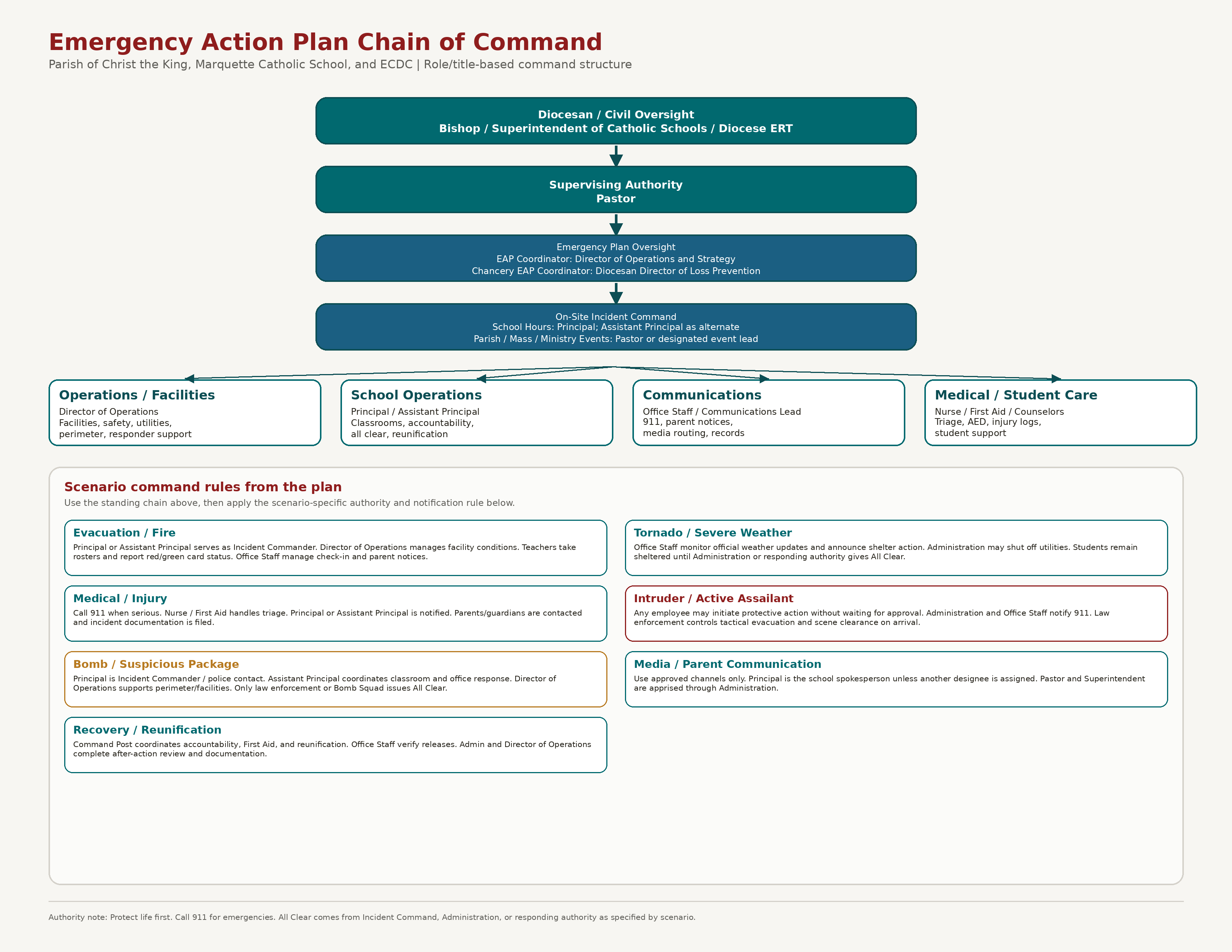
Scenario Command Summary
| Scenario | Command / Coordination Rule |
| Evacuation / Fire | Principal or Assistant Principal serves as Incident Commander. Director of Operations manages facility conditions. Teachers take rosters and report red/green card status. Office Staff manage check-in and parent notices. |
| Tornado / Severe Weather | Office Staff monitor official weather updates and announce shelter action. Administration may shut off utilities. Students remain sheltered until Administration or responding authority gives All Clear. |
| Medical / Injury | Call 911 when serious. Nurse / First Aid handles triage. The Principal or Assistant Principal is notified. Parents/guardians are contacted, and incident documentation is filed. |
| Intruder / Active Assailant | Any employee may initiate protective action without waiting for approval. Administration and Office Staff notify 911. Law enforcement controls tactical evacuation and scene clearance on arrival. |
| Bomb / Suspicious Package | Principal is Incident Commander / police contact. Assistant Principal coordinates classroom and office response. Director of Operations supports perimeter/facilities. Only law enforcement or Bomb Squad issues All Clear. |
| Media / Parent Communication | Use approved channels only. ThePastor is the school spokesperson unless another designee is assigned. Pastor and Superintendent are apprised through Administration. |
| Recovery / Reunification | Command Post coordinates accountability, First Aid, and reunification. Office Staff verify releases. Admin and Director of Operations complete after-action review and documentation. |
Current staffing assignments: Communications Lead — Communication Director Lacy Wulfer; Medical / AED Coordinator — Chris Davenport; Security Liaison — Chris Davenport.
2.2 Notification Contact Sheet
2.3 External Notification (Police / Fire / Diocese)
Facility Codes
| Code | Facility | Description |
| ECDC | Early Childhood Development Center | Serves children ages 3 years old through Pre-K. |
| MARQ | Marquette | K–8 educational facilities. |
| CTKC | Christ the King Church | Parish church facilities. |
| CTKP | Christ the King Parish Office | Parish administrative offices. |
| FLSH | Fletcher Hall / SHEC | Parish hall is used for community and parish events. |
| RECT | Rectory | Priest Residence |
| CTKB | CTK Boiler Room | Sanctuary Basement |
| ROTH | Rother House | Separate parish residences are used for meetings and small gatherings. |
| FOCS | Focus House | 1515 S. Rockford Ave. |
| MARQP | MARQ Playground | |
| ECDCP | ECDC Playground |
REPORTING PROCEDURES-Do not rely on voicemail messages!
| Emergency Type | Action | Responsible Individual / Office & Phone |
| Fire | Call 911 and notify Parish Office | Parish Office – 918-584-4788 |
| Explosion | Call 911 and notify Operations Director | Director of Operations (Chris Davenport) – 918-584-4788 x207 |
| Weather | Notify Parish Office | Parish Office – 918-584-4788 |
| Intruder / Violence | Call 911 and notify Pastor / Principal | Pastor (Fr. Elkin González) / Principal (Jay Lutkemeyer) – 918-584-4631 |
| Medical | Call 911 and notify Main Office | Main Office – 918-584-4631 |
| Poison Control | Contact Poison Control | 1-800-222-1222 |
EMERGENCY RESPONSE TEAM (ERT) (2023)
| Role | Name / Responsibility | Status |
| Supervising Authority | Pastor (Fr. Elkin González) | TBD |
| Emergency Coordinator | Director of Operations (Chris Davenport) | TBD |
| Emergency School Leader – Marquette | Principal (Jay Lutkemeyer) in coordination with the Assistant Principal (Tracey Robinson) | TBD |
| Communications Lead | Communication Director (Lacy Wulfer) | Assigned |
| Medical / AED Coordinator | Chris Davenport | Assigned |
| Security Liaison | Chris Davenport | Assigned |
CHRIST THE KING PARISH Addresses with Alarm Certificates
| Location | Address | Telephone | Alarm Certificate |
| Parish Business Office | 1520 S. Rockford Ave, Tulsa, OK 74120 | 918-584-4788 | Alarm 3000398-2018 |
| Christ the King Rectory | 1419 E. 16th St, Tulsa, OK 74120 | Alarm 000396-2018 | |
| SHEC | 1520 S. Rockford Ave, Tulsa, OK 74120 | Alarm 000394-2018 | |
| ECDC | 1528 S. Quincy Ave, Tulsa, OK 74120 | 918-583-3334 | Alarm 000395-2018 |
| Marquette School | 1519 S. Quincy Ave, Tulsa, OK 74120 | 918-584-4631 | Alarm 000397-2018 |
| Fletcher Hall (Sanctuary) | 1530 S. Rockford Ave, Tulsa, OK 74120 | Alarm 000396-2018 | |
| Rother House | 1604 S. Quincy Ave. Tulsa, Ok 74120 | ||
| FOCS | 1517 S. Rockford Ave. Tulsa, Ok 74120 | ||
| TBD | 1519 S. Rockford Ave. Tulsa, Ok 74120 | ||
| ROTH | 1604 S. Rockford Ave. Tulsa, Ok 74120 |
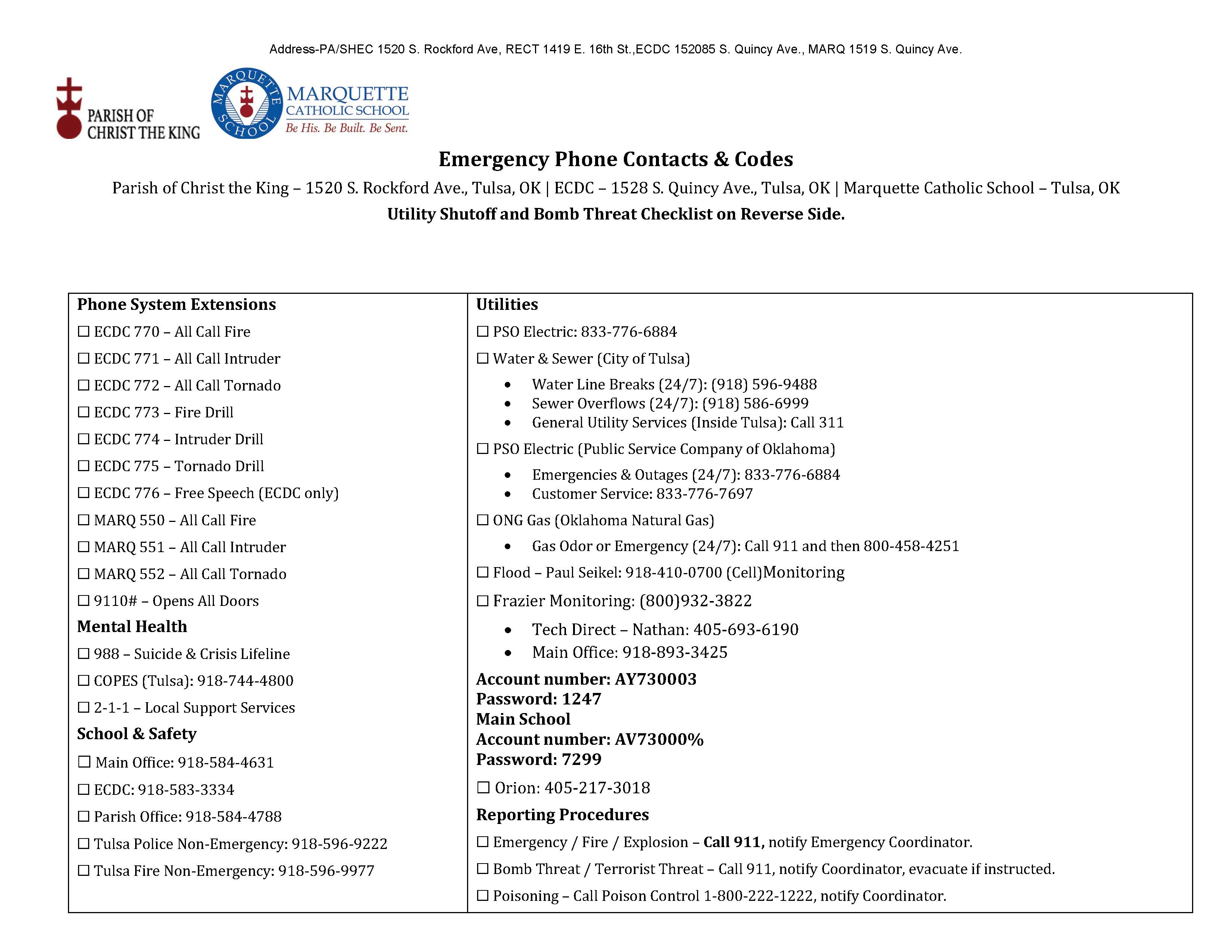
EMERGENCY CONTACT DIRECTORY
| CATEGORY | CONTACT / EXTENSION | DESCRIPTION |
| PHONE SYSTEM EXTENSIONS – ECDC | 770 | All Call – Fire |
| 771 | All Call – Intruder | |
| 772 | All Call – Tornado | |
| 773 | Fire Drill | |
| 774 | Intruder Drill | |
| 775 | Tornado Drill | |
| 776 | Free Speech (ECDC only) | |
| PHONE SYSTEM EXTENSIONS – MARQ | 550 | All Call – Fire |
| 551 | All Call – Intruder | |
| 552 | All Call – Tornado | |
| 9110# | Opens All Doors | |
| MENTAL HEALTH | 988 | Suicide & Crisis Lifeline |
| 918-744-4800 | COPES (Tulsa) | |
| 2-1-1 | Local Support Services | |
| SCHOOL & SAFETY | 918-584-4631 | Main Office |
| 918-583-3334 | ECDC | |
| 918-584-4788 | Parish Office | |
| 918-596-9222 | Tulsa Police – Non-Emergency | |
| 918-595-9977 | Tulsa Fire – Non-Emergency | |
| 911 | Emergency | |
| UTILITIES | 833-776-6884 | PSO Electric |
| 1-800-458-4251 | ONG Gas | |
| 918-596-9488 | Water | |
| 918-586-6999 | Sewer | |
| 918-410-0700 | Flood / Facilities Contact – Paul Seikel | Cell: ________ | |
| CITY & EMERGENCY SERVICES | 918-596-9899 | City of Tulsa |
| 918-599-7999 | Child Abuse Hotline | |
| 1-800-222-1222 | Poison Control Center | |
| 918-581-2401 | Department of Human Services | |
| HOSPITALS | 918-749-2288 | St. John’s Hospital |
| 918-579-1000 | Hillcrest Hospital | |
| 918-494-1420 | St. Francis Hospital | |
| MEDIA & ALERTS | 918-743-2222 | KJRH Channel 2 (NBC) |
| 918-732-6000 | KOTV Channel 6 (CBS) | |
| 918-445-8888 | KTUL Channel 8 (ABC) | |
| 918-493-7400 | KRMG Radio (AM 740 / FM 102.3) | |
| CHURCH CONTACTS | 918-584-6693 | Pastor – Fr. Elkin Gonzalez (Rectory) |
| 918-584-4788 | Christ the King Parish Office | |
| COUNSELING & TESTING | 918-749-1840 | Testing – Dr. Leslie Barnes |
| 918-631-3151 | Testing – Dr. Michael Basso | |
| 918-850-4925 | Counseling – Donna Boswell | |
| 918-284-4615 | Counseling – Dr. Mary Brandt | |
| 918-749-6935 | Counseling – Dr. Chuck McGowen | |
| 918-747-8282 | Counseling & Testing – Dr. Mary Rineer | |
| 918-743-3224 | Counseling – Dr. Mark Sadler |
2.4 Media and Parent Communication
News departments monitor police, fire, and ambulance radio dispatch scanners. Therefore, reporters are aware of most emergency calls and often arrive on the scene very quickly or telephone for immediate information.
In case the news media shows up, please contact the principal or assistant principal. They in turn will apprise Father Elkin Gonzalez and Superintendent, David Dean, of the situation.
Staff Contact Quick Reference
Tornado Fire Environmental Nuclear or Chemical Earthquake
Incident Information
Complete this section as a form →Site: ☐ CTK Parish ☐ MARQ ☐ ECDC Building or Area: _______________________________
Incident Type: _______________________________ Date: ____ / ____ / ______ Start Time: ________ End Time: ________
Building Lead: ____________________________Command Post Location: ______________________________
Emergency Contacts
| Call | Number |
| Emergency Police Fire EMS | 911 |
| Marquette Main Office | 918 584 4631 |
| ECDC Office | 918 583 3334 |
| Parish Office | 918 584 4788 |
| Tulsa Police Non-Emergency | 918 596 9222 |
| Tulsa Fire Non-Emergency | 918 596 9977 |
| Catholic Schools Office | 918 582 9177 |
| Superintendent David Dean | 1 901 626 4974 |
| Principal Cell | 918 510 7299 |
| Assistant Principal Cell | 918 520 6505 |
| Poison Control | 1 800 222 1222 |
| Crisis Lifeline | 988 |
| COPES Tulsa | 918 744 4800 |
Utilities
| Service | Number |
| PSO Electric | 833 776 6884 |
| ONG Gas | 1 800 458 4251 |
| Water | 918 596 9488 |
| Sewer | 918 586 6999 |
| Flood Facilities Contact | 918 410 0700 |
| City of Tulsa | 918 596 9899 |
Campus Addresses
| Location | Address | Phone |
| Parish Business Office | 1520 S. Rockford Ave, Tulsa, OK 74120 | 918 584 4788 |
| Christ the King Rectory | 1419 E. 16th St, Tulsa, OK 74120 | |
| SHEC | 1520 S. Rockford Ave, Tulsa, OK 74120 | |
| ECDC | 1528 S. Quincy Ave, Tulsa, OK 74120 | 918 583 3334 |
| Marquette School | 1519 S. Quincy Ave, Tulsa, OK 74120 | 918 584 4631 |
| Fletcher Hall (Sanctuary) | 1530 S. Rockford Ave, Tulsa, OK 74120 | |
| Rother House | 1604 S. Quincy Ave. Tulsa, Ok 74120 | |
| FOCS | 1517 S. Rockford Ave. Tulsa, Ok 74120 | |
| TBD | 1519 S. Rockford Ave. Tulsa, Ok 74120 |
All Call and Drill Extensions
ECDC
| Extension | Use |
| 770 | All Call Fire |
MARQ
| Extension | Use |
| 550 | All Call Fire |
CTKP MARQ ECDC Emergency Action Quick Reference Plan- Call 911 ASAP !
Site: ☐ CTK Parish ☐ MARQ ☐ ECDC Incident Type: _______________________________ Date: ____ / ____ / ______ Start Time: ________EOP Coordinator: ____________________________________“Parents will be contacted via email and School Reach System.” Parent Reunification-Primary Pickup: ECDC Gym Parking Lot, Secondary: Playground, Third, Society Parking Lot across the street
| CTK / MARQ Extensions and Access | Emergency / Safety / Support | Utilities / Flood |
| ECDC Fire 770 | Emergency 911 | PSO 833-776-6884 |
| ECDC Intruder 771 | 988 Crisis Lifeline | ONG 800-458-4251 |
| ECDC Tornado 772 | COPES 918-744-4800 | Water 918-596-9488 |
| ECDC Fire Drill 773 | 2-1-1 Support | Sewer 918-586-6999 |
| ECDC Intruder Drill 774 | Main Office 918-584-4631 | Flood / Facilities Contact – Paul Seikel 918-410-0700 |
| ECDC Tornado Drill 775 | ECDC 918-583-3334 | Flood Cell ________ |
| ECDC Free Speech 776 | Parish 918-584-4788 | |
| MARQ Fire 550 | TPD 918-596-9222 | |
| MARQ Intruder 551 | TFD 918-596-9977 | |
| MARQ Tornado 552 | ||
| Open All Doors 9110# |
Tulsa Emergency Alert Quick Reference
Official alert sources + immediate action guide for weather, fire, flood, utility, and site emergencies
| Alert word | Plain meaning | Immediate action | Do not |
| Advisory | Conditions may cause inconvenience or limited danger. | Monitor, adjust plans, prepare equipment. | Do not ignore because impact can escalate. |
| Watch | Ingredients are present. Be ready. | Review plan, charge phones/radios, identify shelter/route. | Do not wait until warning to locate shelter. |
| Warning | Hazard is occurring or imminent. Act now. | Move to shelter, evacuate, or protect-in-place based on hazard. | Do not delay for confirmation. |
| Emergency | Rare, severe, life-threatening situation. | Follow official instructions immediately. | Do not travel into the affected area. |
| Evacuation | Leave the area by directed route. | Take go-kit, medicines, contacts, shut doors, account for people. | Do not return until cleared. |
| Shelter-in-place | Stay inside and reduce exposure. | Close doors/windows, move to interior room, monitor alerts. | Do not go outside to investigate. |
Tulsa-specific official alert links
| NWS Tulsa forecast office: open | NWS Tulsa active hazards: open |
| NWS Tulsa NOAA Weather Radio: open | NOAA Weather Radio overview: open |
| City of Tulsa severe weather safety: open | City of Tulsa emergency sirens: open |
| City of Tulsa flood safety: open | Tulsa County Emergency Management: open |
| Ready.gov alerts: open | Oklahoma OEM alert guidance: open |
| U.S. Department of Education REMS TA Center: open | K-12 School EOP Guide - U.S. Department of Education: open |
| SchoolSafety.gov Standard Reunification Method: open |
Immediate decision rule
• Warning = act now, not after discussion.
• Sirens are outdoor warnings; always confirm details using NOAA/NWS, phone alerts, or local emergency management.
• For school/parish/campus use: account for people first, then communicate status, then document issues after life safety is stable.
School decision rule - U.S. Department of Education / REMS framework
| Decision | Use this threshold before moving children | ||
| Take shelter / hold students | Use official warning, site conditions, and Incident Command. For tornadoes or severe wind: shelter immediately. For chemical or nearby hazard: shelter-in-place unless officials order evacuation. | ||
| Release from shelter | Do not release solely because a siren stops. Confirm warning expiration/all-clear, inspect for structural, electrical, gas, flood, debris, and secondary-storm hazards, then account for students/staff. | ||
| Allow parent pickup | Use controlled reunification only after the site is stable, or a safer reunification site is opened. Verify ID, log each student to release, keep emergency lanes open, and communicate one official pickup instruction. | ||
| Evacuate campus | Evacuate for fire, smoke, gas leak, bomb threat, structural instability, flood intrusion, or official order. Move by predetermined routes to accountability/reunification points. | ||
| Tornado Warning TAKE SHELTER NOW | Severe Thunderstorm Warning MOVE INSIDE | Flash Flood Warning AVOID WATER | Fire / Smoke EVACUATE |
| Hazardous Material / Chemical SHELTER OR EVACUATE | Extreme Heat COOL + HYDRATE | Winter / Ice LIMIT TRAVEL | Power / Utility Failure STABILIZE |
Emergency: 911 | Campus/Site Lead: __________________ | Reunification/Accountability Point: __________________
Complete this section as a form →Tornado / Extreme Wind
 | Alert meaning: Warning: Take shelter immediately. Watch: Prepare to shelter quickly. |
Immediate safety precautions
☐ Move to lowest level interior room or approved shelter.
☐ Stay away from windows, glass, exterior doors, gyms, and long-span rooms.
☐ Protect head and neck with arms, coats, cushions, or helmets.
☐ Account for people after the immediate danger passes.
☐ Report injuries, gas smell, downed lines, or blocked exits to 911/site lead.
Avoid these common mistakes
☐ Do not stand at windows or doors.
☐ Do not use large open rooms as shelter.
☐ Do not leave shelter because sirens stop; wait for official all-clear.
School / child-release decision checkpoints
☐ Account for all students, staff, visitors, and groups before release or relocation.
☐ Confirm official all-clear or emergency-management direction; do not rely on sirens alone.
☐ Inspect route, shelter, assembly, and pickup areas for fire, flood, utility, debris, traffic, or security hazards.
☐ Use controlled reunification for parent pickup: ID verification, release log, traffic control, and one official communication channel.
Site notes / assignments
| Primary lead | |
| Backup lead | |
| Shelter / assembly point | |
| After-action issue log |
Official sources: NWS Tulsa | NOAA Weather Radio | City/Tulsa County EM | Ready.gov | Oklahoma OEM | U.S. DOE REMS
Complete this section as a form →Severe Thunderstorm / Lightning / Hail
 | Alert meaning: Warning: damaging wind, hail, or lightning threat is imminent or occurring. |
Immediate safety precautions
☐ Move everyone indoors and away from windows.
☐ Pause outdoor recess, athletics, maintenance, and roof/lift work.
☐ Secure loose outdoor objects only if it can be done before the storm arrives.
☐ Treat destructive wind alerts like tornado risk.
☐ Keep phones/radios charged and monitor NWS Tulsa.
Avoid these common mistakes
☐ Do not shelter under trees.
☐ Do not continue games or events when thunder is heard.
☐ Do not touch wired electronics during close lightning.
School / child-release decision checkpoints
☐ Account for all students, staff, visitors, and groups before release or relocation.
☐ Confirm official all-clear or emergency-management direction; do not rely on sirens alone.
☐ Inspect route, shelter, assembly, and pickup areas for fire, flood, utility, debris, traffic, or security hazards.
☐ Use controlled reunification for parent pickup: ID verification, release log, traffic control, and one official communication channel.
Site notes / assignments
| Primary lead | |
| Backup lead | |
| Shelter / assembly point | |
| After-action issue log |
Official sources: NWS Tulsa | NOAA Weather Radio | City/Tulsa County EM | Ready.gov | Oklahoma OEM | U.S. DOE REMS
Complete this section as a form →Flash Flood / Flooding
 | Alert meaning: Flash Flood Warning: move away from water and low areas immediately. |
Immediate safety precautions
☐ Move to higher ground if water rises near the building or route.
☐ Turn around, do not risk drowning, never drive or walk through floodwater.
☐ Block access to flooded stairwells, basements, and low drives.
☐ Avoid electrical rooms or outlets in wet areas.
☐ Afterward, document damage before cleanup if safe.
Avoid these common mistakes
☐ Do not drive around barricades.
☐ Do not allow children near drainage channels, creeks, or ponding water.
☐ Do not enter flooded basements until power and structure are checked.
School / child-release decision checkpoints
☐ Account for all students, staff, visitors, and groups before release or relocation.
☐ Confirm official all-clear or emergency-management direction; do not rely on sirens alone.
☐ Inspect route, shelter, assembly, and pickup areas for fire, flood, utility, debris, traffic, or security hazards.
☐ Use controlled reunification for parent pickup: ID verification, release log, traffic control, and one official communication channel.
Site notes / assignments
| Primary lead | |
| Backup lead | |
| Shelter / assembly point | |
| After-action issue log |
Official sources: NWS Tulsa | NOAA Weather Radio | City/Tulsa County EM | Ready.gov | Oklahoma OEM | U.S. DOE REMS
Complete this section as a form →Fire / Smoke / Explosion
 | Alert meaning: Alarm, smoke, flame, gas smell, or explosion: evacuate and call 911. |
Immediate safety precautions
☐ Activate alarm if present and call 911 from safe location.
☐ Evacuate using nearest safe exit; close doors behind you.
☐ Assist children, elderly, disabled, or visitors without delaying evacuation.
☐ Meet at accountability point and report missing persons.
☐ Use extinguisher only for small contained fires and only with exit behind you.
Avoid these common mistakes
☐ Do not re-enter for property.
☐ Do not use elevators.
☐ Do not prop fire doors open during alarm response.
School / child-release decision checkpoints
☐ Account for all students, staff, visitors, and groups before release or relocation.
☐ Confirm official all-clear or emergency-management direction; do not rely on sirens alone.
☐ Inspect route, shelter, assembly, and pickup areas for fire, flood, utility, debris, traffic, or security hazards.
☐ Use controlled reunification for parent pickup: ID verification, release log, traffic control, and one official communication channel.
Site notes / assignments
| Primary lead | |
| Backup lead | |
| Shelter / assembly point | |
| After-action issue log |
Official sources: NWS Tulsa | NOAA Weather Radio | City/Tulsa County EM | Ready.gov | Oklahoma OEM | U.S. DOE REMS
Complete this section as a form →Hazardous Material / Chemical / Siren Shelter
 | Alert meaning: Chemical release or official shelter-in-place order: reduce outside-air exposure. |
Immediate safety precautions
☐ Go indoors immediately and move to interior rooms.
☐ Close exterior doors/windows and shut down outside-air intake if trained/authorized.
☐ Keep people away from affected air, spill, vapor, or suspicious substance.
☐ Monitor City of Tulsa, Tulsa County EM, NWS, and official instructions.
☐ Prepare for evacuation if officials change direction.
Avoid these common mistakes
☐ Do not go outside to look.
☐ Do not touch, smell, or clean unknown substances without direction.
☐ Do not self-deploy into a contaminated area.
School / child-release decision checkpoints
☐ Account for all students, staff, visitors, and groups before release or relocation.
☐ Confirm official all-clear or emergency-management direction; do not rely on sirens alone.
☐ Inspect route, shelter, assembly, and pickup areas for fire, flood, utility, debris, traffic, or security hazards.
☐ Use controlled reunification for parent pickup: ID verification, release log, traffic control, and one official communication channel.
Site notes / assignments
| Primary lead | |
| Backup lead | |
| Shelter / assembly point | |
| After-action issue log |
Official sources: NWS Tulsa | NOAA Weather Radio | City/Tulsa County EM | Ready.gov | Oklahoma OEM | U.S. DOE REMS
Complete this section as a form →Extreme Heat
 | Alert meaning: Heat advisory/warning: reduce heat exposure and watch vulnerable people. |
Immediate safety precautions
☐ Move activities to shade or air conditioning.
☐ Hydrate and schedule rest breaks.
☐ Check children, elderly, medically vulnerable persons, and outdoor workers.
☐ Watch for confusion, fainting, hot dry skin, or heat stroke signs; call 911.
☐ Never leave children, adults, or pets in parked vehicles.
Avoid these common mistakes
☐ Do not overexert during midday heat.
☐ Do not rely on fans alone in dangerous heat.
☐ Do not ignore heat illness symptoms.
School / child-release decision checkpoints
☐ Account for all students, staff, visitors, and groups before release or relocation.
☐ Confirm official all-clear or emergency-management direction; do not rely on sirens alone.
☐ Inspect route, shelter, assembly, and pickup areas for fire, flood, utility, debris, traffic, or security hazards.
☐ Use controlled reunification for parent pickup: ID verification, release log, traffic control, and one official communication channel.
Site notes / assignments
| Primary lead | |
| Backup lead | |
| Shelter / assembly point | |
| After-action issue log |
Official sources: NWS Tulsa | NOAA Weather Radio | City/Tulsa County EM | Ready.gov | Oklahoma OEM | U.S. DOE REMS
Complete this section as a form →Winter Weather / Ice
 | Alert meaning: Winter storm/ice warning: stay off roads when possible and prevent cold injury. |
Immediate safety precautions
☐ Limit travel and monitor road/closure information.
☐ Dress in layers and keep people dry.
☐ Use safe heating only; keep generators outdoors.
☐ Treat sidewalks, stairs, and entrances for slip hazards.
☐ Protect pipes and critical mechanical spaces when freezing conditions are expected.
Avoid these common mistakes
☐ Do not use ovens or grills for heat.
☐ Do not run generators indoors or near openings.
☐ Do not assume clear-looking pavement is safe.
School / child-release decision checkpoints
☐ Account for all students, staff, visitors, and groups before release or relocation.
☐ Confirm official all-clear or emergency-management direction; do not rely on sirens alone.
☐ Inspect route, shelter, assembly, and pickup areas for fire, flood, utility, debris, traffic, or security hazards.
☐ Use controlled reunification for parent pickup: ID verification, release log, traffic control, and one official communication channel.
Site notes / assignments
| Primary lead | |
| Backup lead | |
| Shelter / assembly point | |
| After-action issue log |
Official sources: NWS Tulsa | NOAA Weather Radio | City/Tulsa County EM | Ready.gov | Oklahoma OEM | U.S. DOE REMS
Complete this section as a form →Power / Utility Failure
 | Alert meaning: Power outage, gas leak, water main break, or downed line: stabilize and isolate. |
Immediate safety precautions
☐ Call 911 for downed lines, gas smell, fire, or life-safety threat.
☐ Keep people away from electrical hazards and wet energized areas.
☐ Use flashlights instead of candles when possible.
☐ Keep refrigerators/freezers closed if outage is short.
☐ Generators must remain outside and away from doors/windows.
Avoid these common mistakes
☐ Do not touch downed wires.
☐ Do not use generators indoors, in garages, or near air intakes.
☐ Do not reset breakers repeatedly without identifying cause.
School / child-release decision checkpoints
☐ Account for all students, staff, visitors, and groups before release or relocation.
☐ Confirm official all-clear or emergency-management direction; do not rely on sirens alone.
☐ Inspect route, shelter, assembly, and pickup areas for fire, flood, utility, debris, traffic, or security hazards.
☐ Use controlled reunification for parent pickup: ID verification, release log, traffic control, and one official communication channel.
Site notes / assignments
| Primary lead | |
| Backup lead | |
| Shelter / assembly point | |
| After-action issue log |
Official sources: NWS Tulsa | NOAA Weather Radio | City/Tulsa County EM | Ready.gov | Oklahoma OEM | U.S. DOE REMS
Complete this section as a form →Medical / Accountability / Reunification
 | Alert meaning: Use after any emergency involving injury, missing persons, evacuation, or family pickup. |
Immediate safety precautions
☐ Call 911 for life-threatening injury or worsening condition.
☐ Start first aid/AED/CPR only if trained or directed.
☐ Account for people by room, class, group, or event roster.
☐ Use a single reunification point and controlled release process.
☐ Document injuries, missing persons, property hazards, and notifications.
Avoid these common mistakes
☐ Do not move seriously injured persons unless danger remains.
☐ Do not release children without approved process.
☐ Do not spread unverified information.
School / child-release decision checkpoints
☐ Account for all students, staff, visitors, and groups before release or relocation.
☐ Confirm official all-clear or emergency-management direction; do not rely on sirens alone.
☐ Inspect route, shelter, assembly, and pickup areas for fire, flood, utility, debris, traffic, or security hazards.
☐ Use controlled reunification for parent pickup: ID verification, release log, traffic control, and one official communication channel.
Site notes / assignments
| Primary lead | |
| Backup lead | |
| Shelter / assembly point | |
| After-action issue log |
Official sources: NWS Tulsa | NOAA Weather Radio | City/Tulsa County EM | Ready.gov | Oklahoma OEM | U.S. DOE REMS
Official Source Appendix
Use these sources for current alerts, warning definitions, school emergency operations planning, reunification, and official preparedness guidance. Printed copies should be reviewed at least annually and after any policy or site change.
NWS Tulsa forecast office: https://www.weather.gov/tsa/
NWS Tulsa active hazards: https://www.weather.gov/tsa/hazards
NWS Tulsa NOAA Weather Radio: https://www.weather.gov/tsa/weather_radio
NOAA Weather Radio overview: https://www.weather.gov/nwr
City of Tulsa severe weather safety: https://www.cityoftulsa.org/residents/public-safety/weather/
City of Tulsa emergency sirens: https://www.cityoftulsa.org/residents/public-safety/emergency-sirens/
City of Tulsa flood safety: https://www.cityoftulsa.org/government/departments/water-and-sewer/flood-control/flood-safety/
Tulsa County Emergency Management: https://www2.tulsacounty.org/community/tulsa-county-emergency-management/
Ready.gov alerts: https://www.ready.gov/alerts
Oklahoma OEM alert guidance: https://oklahoma.gov/oem/news/newsroom/12-ways-to-prepare--practice-emergency-drills-112.html
U.S. Department of Education REMS TA Center: https://rems.ed.gov/
K-12 School EOP Guide - U.S. Department of Education: https://rems.ed.gov/docs/REMS_K-12_Guide_508.pdf
SchoolSafety.gov Standard Reunification Method: https://www.schoolsafety.gov/resource/standard-reunification-method-volume-2
Tulsa Outdoor Warning Siren System
Tulsa operates more than 80 outdoor warning sirens across the city. Sirens are intended primarily to warn people who are outdoors about immediate danger and are audible for approximately one mile under normal conditions.
Sirens are only one part of Tulsa’s emergency warning system. Citizens should also monitor NOAA Weather Radio, NWS Tulsa alerts, local news media, wireless emergency alerts, and official emergency-management notifications.
Steady Tone (3 Minutes): A continuous steady tone warns of tornadoes or hazardous material / chemical releases. Seek shelter immediately and monitor official information sources.
Wavering Tone (3 Minutes): A wavering or wailing tone warns of nuclear attack. Seek immediate shelter and monitor emergency broadcasts.
High-Low Tone (3 Minutes): A repeating high-low tone warns of flooding. Move away from low-lying areas and never drive through floodwaters.
Upon hearing either the steady or wavering tones, move to shelter immediately and monitor official media sources for instructions. Upon hearing the flood tone, avoid flood-prone roadways, creeks, drainage channels, and water crossings.
Tulsa sirens are tested each Wednesday at noon, weather permitting. Tests are generally one minute in duration. Actual emergency warnings are three-minute activations.
School / Parish / Campus Guidance: Sirens alone should not determine release decisions. Use official warnings, emergency-management guidance, site conditions, accountability status, transportation safety, and Incident Command review before allowing parent pickup or release.
Complete this section as a form →3.6 Violence or Intruder Response (Active Assailant)
☐ A – Alert, communicate threat, Announce in plain language (intercom/radio/phone). If safe, call 911. Share location, description, and direction.
☐ L – Lockdown, Secure location, Lock/barricade. Lights off. Silence phones. Move out of sight. Stay quiet, stay alert.
☐ I – Inform, Update others, Relay real-time updates (radio/text/intercom) to support decisions: where / movement / status.
☐ C – Counter, disrupt if trapped, only if in immediate danger and cannot escape to create distraction (noise, movement, throw objects).
☐ E – Evacuate, Escape if safe, Exit by safest route (not necessarily normal). Take others if possible. Rally point.
| Emergency Equipment / Control | Primary Use Case | Where It Is Typically Located | Who Uses It | Immediate Steps (Do First) | Do Not / Critical Notes |
| Fire Extinguisher (Portable) | Small, contained fire in early stage | Mounted cabinets or wall brackets in corridors, mechanical rooms, kitchens, near exits | Trained staff | Alert others, call 911 if needed, pull pin, aim at base, squeeze, sweep; keep exit behind you | Do not fight fire if smoke is heavy, fire is spreading, or you lack a clear exit; evacuate and close doors |
| Fire Alarm Pull Station | Activate building alarm / initiate evacuation | Near exits, major corridors, stairwells | Any staff | Pull station; notify Main Office / EOP Coordinator; initiate evacuation roles | Do not delay activation to confirm smoke source; activate if credible danger |
| Fire Sprinkler System (Automatic) | Automatic suppression of fire | Whole building system; valves in sprinkler riser room / mechanical area | Facilities / authorized personnel | If activated, evacuate; call 911; identify area; secure utilities if directed by responders | Do not shut off sprinkler valves unless directed by Fire Dept / Incident Commander |
| Fire Suppression Hood System (Kitchen/Range) | Grease/hood fires | Kitchen hood over cooking line; manual pull nearby | Kitchen staff + trained staff | Turn off cooking equipment; activate hood system (manual pull if needed); evacuate if not immediately controlled; call 911 | Do not use water on grease fires; avoid re-ignition; do not restart equipment |
| Emergency Gas Shutoff (Natural Gas) | Gas smell, leak, fire risk | Exterior meter/regulator; mechanical room; labeled valve location | Facilities / authorized personnel (or Fire Dept) | Evacuate immediate area; call 911; if safe and trained, shut off gas; account for occupants | Do not operate electrical switches, radios, or phones in suspected leak area; do not re-open gas without utility clearance |
| Electrical Main Disconnect / Breaker Panel | Electrical hazard, smoke from equipment, flooding risk | Electrical rooms, labeled panels, mechanical rooms | Facilities / authorized personnel | If hazard is imminent and safe, isolate affected circuit or use main disconnect; call 911 if fire/smoke | Do not touch panels if standing water is present; treat as energized until confirmed safe |
| Water Main Shutoff | Major leak, burst pipe, flooding | Water service entry, mechanical room, exterior meter pit | Facilities / authorized personnel | Shut off water if safe; protect critical areas; notify EOP Coordinator; call water utility for major breaks | Do not enter flooded electrical/mechanical spaces without clearance |
| Emergency Generator (if present) | Critical power during outage | Generator enclosure, mechanical area | Facilities / vendor | Notify EOP Coordinator; follow posted start/transfer procedure; monitor alarms; document runtime | Do not attempt manual transfer unless trained; keep exhaust/ventilation clear |
| AED (Automated External Defibrillator) | Cardiac arrest | Main office, gym, nurse area, high-traffic marked cabinet | Any trained staff (and guided by AED prompts) | Call 911; retrieve AED; start CPR; follow voice prompts; assign runner to guide EMS | Do not delay CPR while searching; keep pads dry/clear of medication patches |
| First Aid Kit / Trauma Kit | Bleeding, injury stabilization | Main office, nurse area, gym, key program rooms | Trained staff | Call 911 for severe injuries; apply gloves; control bleeding; document | Do not move injured person unless life-threatening hazard exists |
Tornado Severe Weather Disaster Response
Immediate Actions
Office staff continuously monitor weather updates from official sources.
When a severe thunderstorm or tornado watch is issued, staff are alerted to review procedures.
When a tornado warning or imminent threat occurs, announce: "Attention: Move immediately to your designated shelter area.”
If power is out, designated staff will notify each floor manually.
If time allows, dismiss in this order: top floor then main floor then basement.
Teachers secure rooms by closing and locking doors and windows. Take your class roster.
All staff assist regardless of assignment. Verify restrooms are unoccupied and move students to the nearest safe area.
Students remain silent and in position until ALL CLEAR is given.
Administration may shut off utilities as required.
Aftermath
Move everyone from damaged to undamaged areas or to the Safety Zone at the Playground if safe.
If injuries occur, restore breathing and control bleeding immediately. Notify the office or emergency personnel.
Keep anyone injured comfortable and warm.
Keep students calm and group together.
Follow evacuation instructions if ordered.
If the building is intact, but area damage is widespread, remain sheltered until authorities issue release orders.
Parent Reunification Locations
| Tier | Location |
| Primary | ECDC Gym Parking Lot |
| Secondary | Playground |
| Tertiary | Society Parking Lot across the street |
Fire Response
Activate the fire alarm.
Evacuate immediately using posted routes. Use alternate exits if blocked.
Call 911 after evacuation.
Assist injured or mobility impaired individuals.
Close doors and windows. Do not lock doors.
Do not collect personal items.
Move 100 feet from the building and keep drives clear for emergency vehicles.
Look carefully for signs of Smoke and Fire. If detected, avoid it! Do not risk burning or dangerous inhalation of burning chemicals. See Smoke and stay calm, stay away!
Accountability
Teachers take attendance using rosters.
Display green card if all students are present and red card if missing students.
Report unaccounted students to the Principal or Assistant Principal immediately.
Do not reenter until the All Clear is announced.
Assembly Areas
| Primary | Secondary |
| ECDC Parking Lot | Playground |
Environmental Disaster Contaminated Air or Water
For water contamination, announce: Do not consume any water from facility sources. Provide bottled or safe external supply.
If air contamination is inside, initiate Fire Drill evacuation procedure.
If air contamination is outside, shut down HVAC and remain indoors until directed.
Communication
Call 911.
Tulsa Police: 918 596 9222
Catholic Schools Office: 918 582 9177
Superintendent David Dean: 1 901 626 4974
Parents will be contacted via email and the School Reach system.
Nuclear or Chemical Contamination Disaster
Initiate the tornado procedure to move to the lowest interior shelter.
Shut off air handling systems as needed.
Follow instructions from police and rescue personnel.
Be prepared for extended shelter in place until safe transport is arranged.
Earthquake Response
Command: EARTHQUAKE TAKE COVER DUCK AND HOLD.
Students get under desks, cover heads, and hold until shaking stops.
Expect alarms or sprinklers. Remain calm.
After shaking stops, evacuate using Fire Drill routes to the Playground Safety Zone.
Account for all students and report injuries to administrators.
If indoors, avoid glass and hanging fixtures.
If outdoors, stay clear of trees, buildings, and power lines.
If in vehicles, pull over safely and remain until shaking stops.
Key Reminders
All Clear is issued by authorities or administration.
Do not dismiss students until authorized and accountability is complete.
Use only approved communication channels for parent me
Complete this section as a form →Administration Emergency Action Quick Reference Plan
Incident Information
Site: ☐ CTK Parish ☐ MARQ ☐ ECDC Building or Area: _______________________________
Incident Type: _______________________________ Date: ____ / ____ / ______ Start Time: ________ End Time: ________
Incident Commander: _______________________________ Command Post Location: _______________________________
Complete this section as a form →Evacuation Procedures
Activate alarm or announce via intercom: Attention: Evacuate the building. Follow evacuation routes. Confirm 911 call and notify Parish Office.
Immediate Actions
☐ Activate fire alarm or announce evacuation as appropriate.
☐ Confirm 911 call has been placed or direct an adult to call 911 immediately when safe.
☐ Notify Parish Office and Administration.
☐ Teachers bring rosters, red and green cards, and emergency folders.
☐ Lead students to designated Safety Zone using posted routes. Use alternate exits if blocked.
☐ Assist injured or mobility impaired individuals.
☐ Close doors and windows. Do not lock doors.
☐ Do not collect personal items.
☐ Move 100 feet from building and keep drives clear for emergency vehicles.
Accountability and Check In
☐ Conduct roll call upon arrival using the class roster. Do not count heads.
☐ Display Green Card if all students are present. Display Red Card if missing or injured.
☐ If any students are unaccounted for, write names and last known location and send immediately to the Evacuation Center Check In location.
☐ Submit Student Accountability Sheet to the Check In Table.
☐ Do not reenter until All Clear is announced by authorities or administration.
Parent Communication and Pick Up
Parents, guardians, and designated drivers are asked to not immediately pick up their child from the teacher's line outside. This prevents accurate accountability.
☐ Parents will be notified through School Reach Phone System and by email.
☐ A pass will be issued to parents upon checking in at the Evacuation Center.
☐ Parents give the pass to the child’s teacher. The teacher releases the child and records the release on the roster and the Reunification Log.
☐ Reunification occurs only after ID verification through RenWeb or FACTS and completion of the Reunification Log.
Parent Communication Scripts and Templates
Use only when authorized by Incident Command. Keep messages factual, brief, and action oriented.
Evacuation Status Update
Marquette and ECDC are responding to an emergency and have moved students to a safety zone. Students are safe and supervised. Please do not come to campus until reunification instructions are issued. Additional updates will follow.
Reunification Instructions
Student reunification will occur at the designated reunification location. Bring a photo ID. Students will be released only to authorized adults verified through RenWeb FACTS. Please remain in your vehicle and follow staff directions to the Check In table.
Delayed Dismissal or Shelter Notice
For safety, the campus is sheltering in place at this time. Students are safe. Do not attempt to enter campus. We will notify families when conditions change and provide the next steps.
All Clear and Controlled Return
An All Clear is issued by authorities. Staff will conduct a controlled return and continue accountability procedures. Students will be released through normal dismissal or reunification procedures as directed.
Evacuation Command Post Setup
Set up Command Post, First Aid Station, and Parent Reunification area as outlined below.
| Station | Function | Personnel |
| Check In Table | Collects accountability sheets | Office Staff |
| First Aid Treatment Area | Triage and minor medical response | Nurse Admin Assistant |
| Parent Reunification | Verifies guardians and logs releases | Secretarial Team |
| Command Post | Incident command, responder coordination, communications | Principal Assistant Principal Director of Operations |
Evacuation Sites
| Tier | Location | Use Case |
| Primary | Playground Safety Zone | General evacuation |
| Secondary | ECDC Parking Lot | Fire or weather emergency |
| Tertiary | Society Lot across 15th Street | Bomb threat or structural hazard |
APPENDIX- Student Accountability Checklist
| Task | Responsible | Verified | Notes |
| Students evacuated via posted route | Teacher | ☐ | |
| Roll call completed | Teacher | ☐ | |
| Green or Red card displayed | Teacher | ☐ | |
| Missing or injured list submitted | Teacher | ☐ | |
| First Aid provided | Nurse Admin | ☐ | |
| Students released only to authorized adults | Office Staff | ☐ | |
| All Clear issued by authorities | Principal | ☐ | |
| After Action Report filed | Admin Director of Operations | ☐ |
Parent Reunification Process
☐ Parents check in at the Parent Reunification station.
☐ Parent or guardian identity is verified using RenWeb or FACTS and a valid ID.
☐ Parent receives a pass upon check in.
☐ Parent gives the pass to the teacher.
☐ Teacher releases the student only after the pass is presented and release is recorded.
☐ Office staff records release on the Parent Reunification Log.
☐ Do not dismiss any student until the official word is given to do so.
Student Accountability Sheet
Have Leaders submit this sheet to the Check In Table immediately after roll call.
Group Lead: _______________________________ Grade or Room: _______________________________
Evacuation Start Time: ________ Arrival Time at Safety Zone: ________ Safety Zone Location: _______________________________
Students Assigned to This Group: ________ Students Present: ________ Green Card Displayed: ☐ Red Card Displayed: ☐
Students Missing or Unaccounted
| Student Name | Last Known Location | Time Noted | Reported To |
Students Injured or Needing Medical Attention
| Student Name | Injury or Concern | First Aid Given | Transferred To |
Additional Students Pulled in From Hallway or Other Rooms
| Student Name | Home Teacher or Room | Time Pulled In | Notes |
Parent Reunification Log
ID verification is required for every release.
| Student Name | Teacher Class | Parent Guardian Name | ID Verified | Time Released Staff Initials |
| ☐ | ||||
| ☐ | ||||
| ☐ | ||||
| ☐ | ||||
| ☐ | ||||
| ☐ | ||||
| ☐ | ||||
| ☐ | ||||
| ☐ | ||||
| ☐ |
Medical Emergency Documentation and Scene Control
Scene Safety
☐ Assess personal risk before intervening.
☐ Use gloves when blood is present and follow infection control practice.
☐ Do not move an injured person unless required for immediate life safety.
Documentation Essentials
☐ Record time, location, presenting condition, actions taken, and transfer to EMS.
☐ Notify Administration and parent or guardian when applicable.
☐ Submit incident documentation per policy for retention.
Complete this section as a form →APPENDIX- Recovery Restoration and Post Incident Actions Quick Checklist
Facility Re Entry and Damage Assessment
☐ Do not reenter until it is cleared by authorities.
☐ Document damage and hazardous areas. Restrict access as needed.
☐ Confirm utilities status and restore only when safe and authorized.
Student and Staff Support
☐ Coordinate counseling support as directed by Administration.
☐ Use controlled communication to reduce rumors and misinformation.
☐ Provide factual updates to staff and parents through approved channels.
Documentation
☐ Complete After-Action Report and corrective action log.
☐ Retain reunification logs and accountability sheets.
☐ Submit required reports to diocesan leadership when applicable.
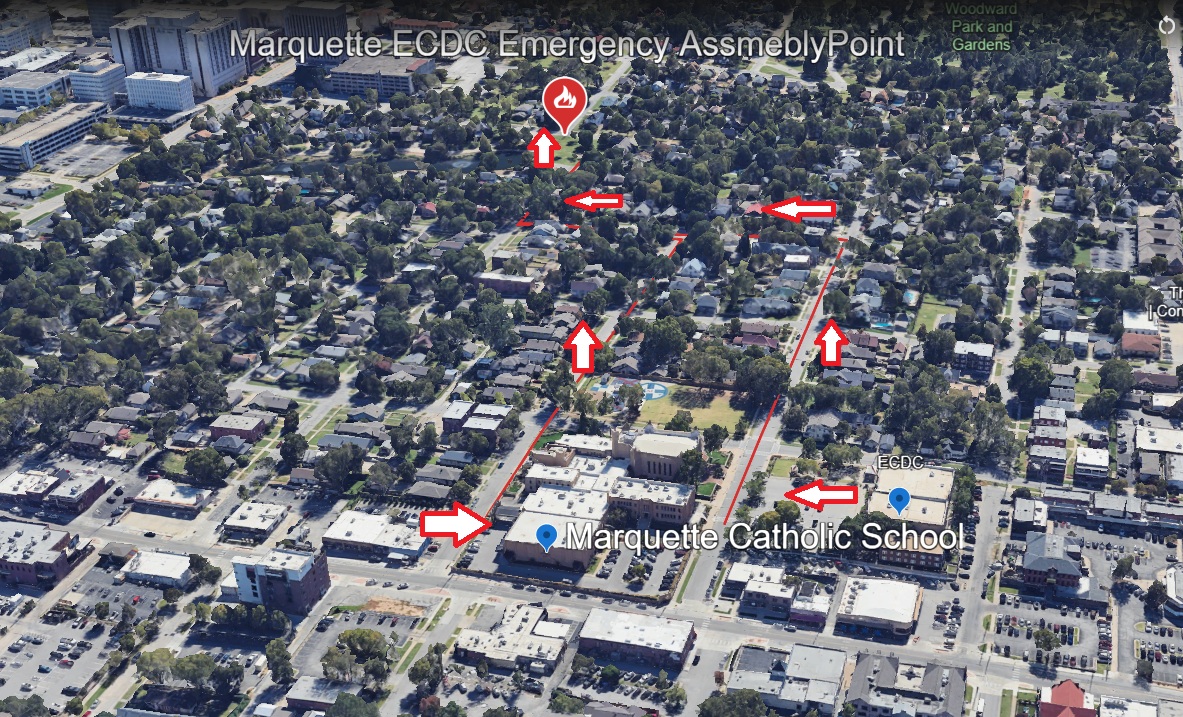
APPENDIX – MAP Assembly Areas
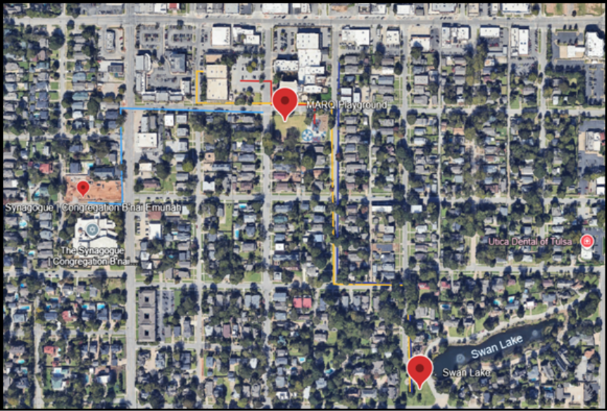
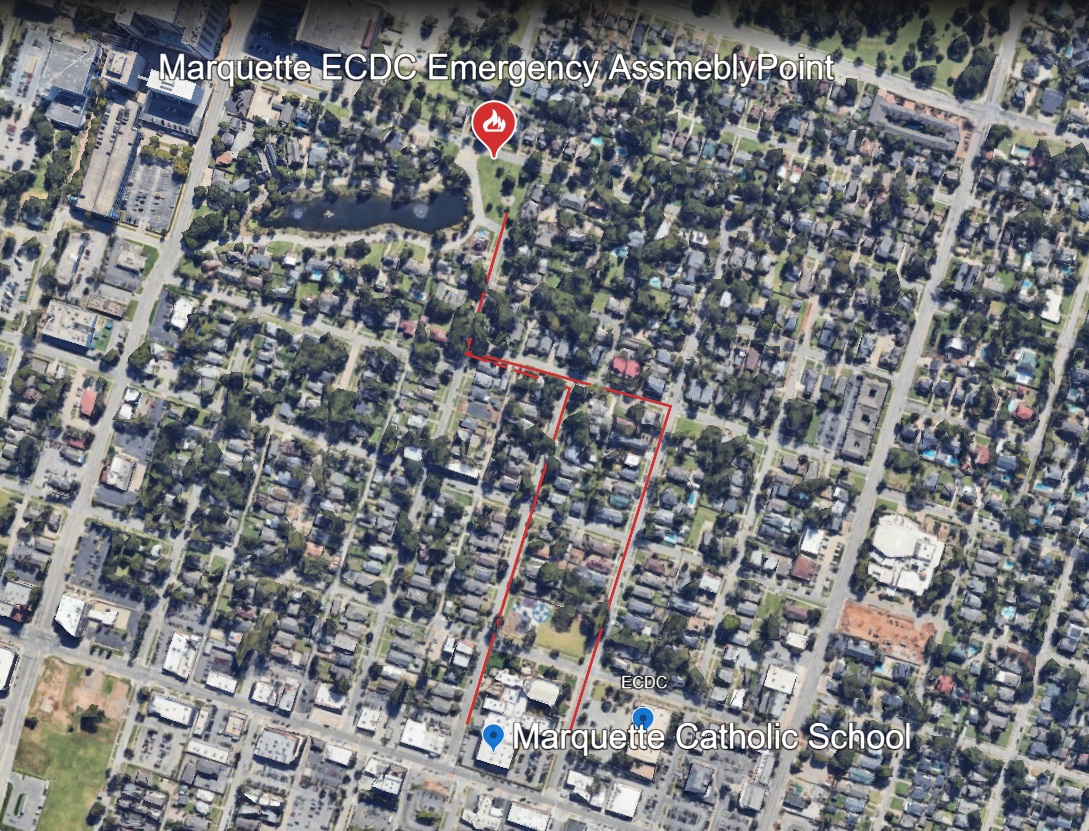
Parish of Christ The King/ MarquetterEmergency Assemble Point Swan Lake
APPENDIX– MAP AED, Fire Extinguisher and Shelter Locations
Complete this section as a form →Extinguishers
Use extinguishers only when you are trained, and the fire is small, contained, and you have a clear exit path.
| Step | Action |
| P | Pull the pin |
| A | Aim at the base of the fire |
| S | Squeeze the handle |
| S | Sweep side to side at the base |
☐ If smoke conditions worsen or the fire grows, evacuate immediately and close the door behind you.
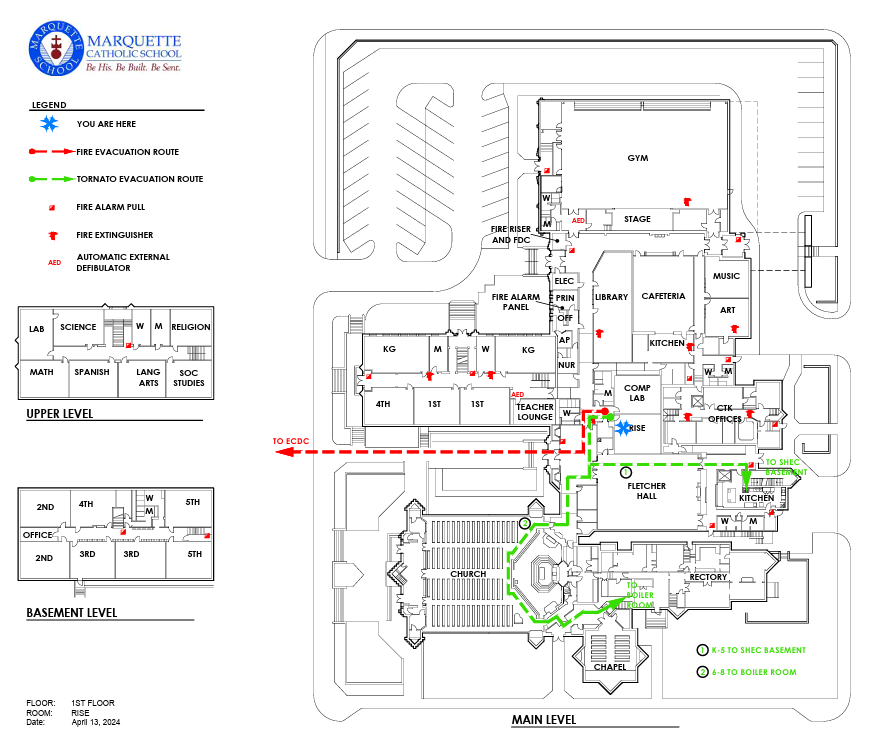
APPENDIX- ECDC AED, Fire Extinguisher and Shelter Map (1528 S. Quincy Ave. Tulsa, Ok 74120)
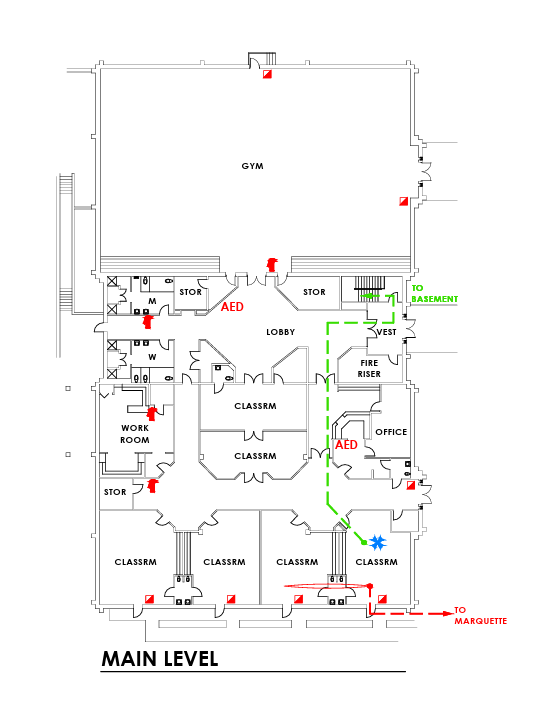
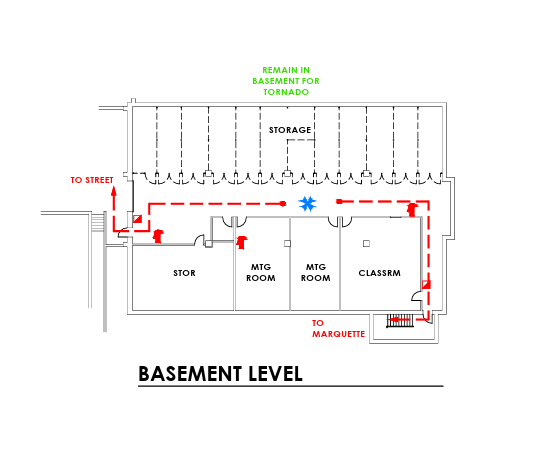
APPENDIX- Chapel & Sanctuary AED, Fire Extinguisher and Shelter Map
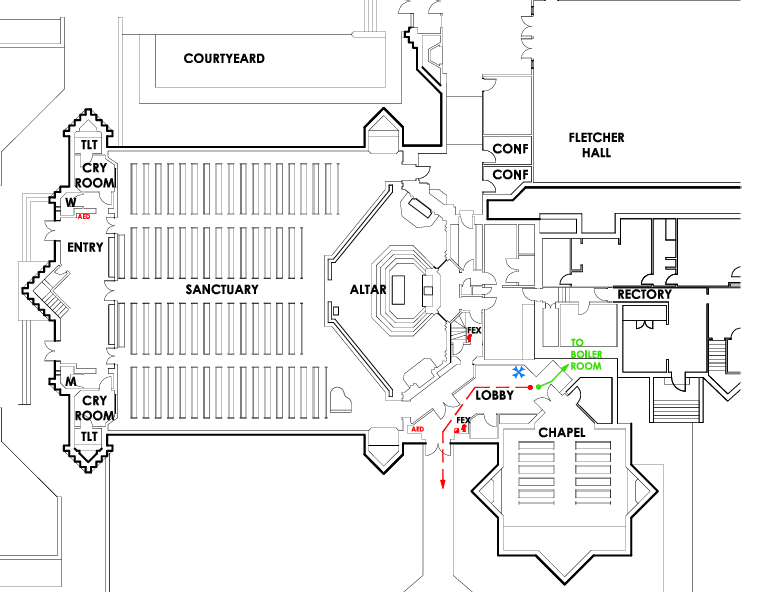
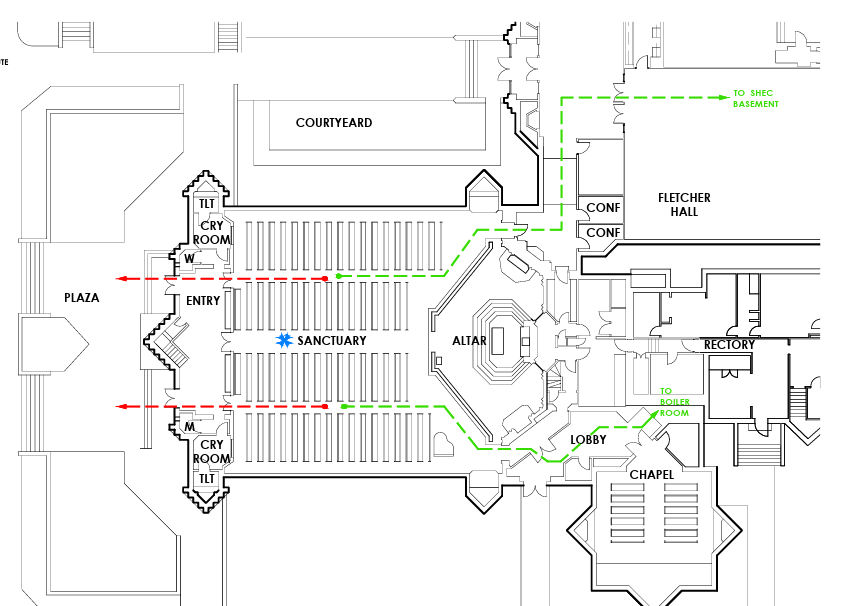
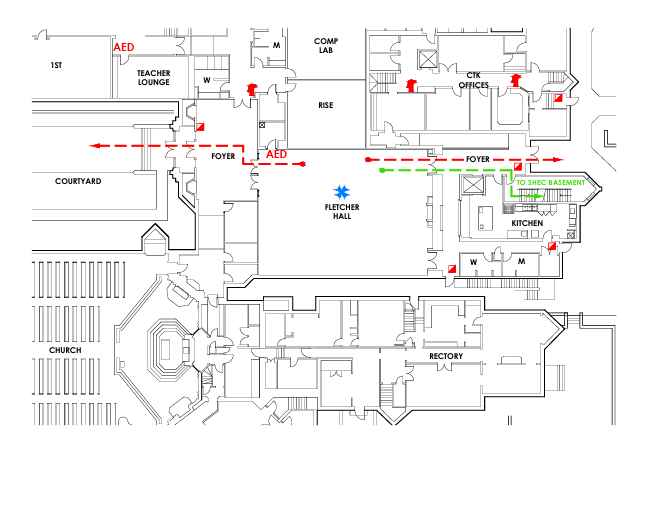
APPENDIX- Parish Office & FLSH AED, Fire Extinguisher and Shelter Map
APPENDIX- Tornado Severe Weather Shelter Quick Guidance
Shelter Behavior
☐ Use lowest interior areas away from windows when directed.
☐ Maintain silence and supervision so instructions can be heard.
☐ Protect head and neck. Sit facing interior wall when possible.
All Clear and Dismissal
☐ Remain sheltered until All Clear is announced.
☐ Dismissal after severe weather is controlled by Administration and may follow tiered release instructions.
Immediate Actions
☐ Office staff continuously monitor weather updates from official sources.
☐ When a severe thunderstorm or tornado watch is issued, staff are alerted to review procedures.
☐ When a tornado warning or imminent threat occurs, announce: Attention: Move immediately to your designated shelter area.
☐ If power is out, designated staff notify each floor manually.
☐ If time allows, dismiss in this order: top floor, then main floor, then basement.
☐ Teachers secure rooms by closing and locking doors and windows when time allows and bring rosters.
☐ All staff assist regardless of assignment. Inspect restrooms and move students to the safest area.
☐ Students remain silent and in position until ALL CLEAR is given.
☐ Administration may shut off utilities as required.
Aftermath Tornado
☐ Move everyone from damaged to undamaged areas or to the Safety Zone at the Playground if safe.
☐ If injuries occur, restore breathing and control bleeding immediately. Notify office or emergency personnel.
☐ Keep anyone injured comfortable and warm.
☐ Keep students calm and group together.
☐ Follow evacuation instructions if ordered.
☐ If the building is intact but area damage is widespread, remain sheltered until authorities issue release orders.
Parent Reunification
Primary Pickup: ECDC Gym Parking Lot
Secondary: Playground
Tertiary: Society Parking Lot across the street
Complete this section as a form →APPENDIX- Emergency Action Plan for Active Intruder ALICE
Intruder Lockdown Guidance Key
Immediate Priorities
☐ Act immediately when you observe behavior or conditions that indicate danger. You do not need permission to protect life.
☐ Communicate threat location in plain language when safe to do so.
☐ Clear hallways by bringing students into the nearest room.
☐ Lock or barricade doors. Turn off the lights when appropriate. Silence devices.
☐ Maintain accountability. Use a Green Card when everyone is accounted for. Use a Red Card when someone is missing or injured.
Threat Outside Versus Threat Inside
| Situation | Primary Objective | Expected Staff Action |
| Threat outside building | Keep threat outside | Lock exterior doors, stay away from windows, shelter in rooms, and continue internal operations when directed. |
| Threat inside building | Survive and reduce exposure | Lock or barricade, stay out of sight, remain quiet, prepare to evacuate if safe route becomes available, follow law enforcement direction for evacuation. |
Law Enforcement Arrival
☐ Remain calm and follow all instructions.
☐ Keep hands visible and empty. Do not run toward officers.
☐ Evacuate only when directed by law enforcement during a lockdown evacuation.
☐ Do not dismiss any student until official release is authorized.
Purpose: Provide clear, real-time procedures for staff, parishioners, volunteers, and visitors during an active intruder or violent threat. Protect life first.
Situational Awareness
☐ Stay alert to unusual behavior, sounds, or disturbances.
☐ Trust your instincts. If something feels wrong, act immediately.
☐ Identify exits, potential barricade materials, and communication options.
☐ Every second matters. Do not wait for confirmation before acting to protect yourself or others.
Complete this section as a form →APPENDIX-ALICE Emergency Response Procedures
| Step | Action | Key Directives |
| A Alert | Clearly communicate the threat immediately. | Use intercom, radio, or phone to announce the threat in plain language. If safe, call 911. Share location, description, and direction of movement. |
| L Lockdown | Secure your location. | Lock or barricade doors using furniture. Turn off lights, silence phones, and move out of sight. Stay quiet but alert. |
| I Inform | Keep communication open. | Relay real time information. Provide updates such as intruder moving toward the gym. |
| C Counter | Distract and disrupt only if in immediate danger. | If breached and escape is impossible, create confusion using noise and movement. Disruption is the goal of creating an opportunity to escape. |
| E Evacuate | Escape the danger zone if safe. | Leave immediately through any safe exit. Take others with you, but don't wait. Move to rally points and call 911 once safe. |
Lockdown Guidance
☐ Clear halls. Bring any students in the hall into your room. Make a list of additional students and their home teacher and tape the window of the door.
☐ Include any missing children from your classroom on the same list.
☐ Place a predesignated colored card outside your door on the floor. Green means everyone is accounted for. Red means a child is missing or hurt.
☐ If no card is placed, administration and law enforcement will assume an intruder is in the room.
☐ If the threat is outside the building, lock exterior doors, pull shades, stay away from windows.
☐ If the threat is inside, leave blinds open so responders can see into rooms.
☐ Evacuate only if instructed by law enforcement. Take a gradebook or emergency folder. Keep the class together.
☐ Do not dismiss any student until the official word is given to do so.
Complete this section as a form →APPENDIX- LOCKDOWN
Lockdown Classroom List Sheet
Tape this list to the window of the door during lockdown.
Teacher or Room: ____________________Date: ____ / ____ / ______ Time: ____________
Green Card Placed: ☐ Red Card Placed: ☐
Additional Students Pulled in From Hallway
| Student Name | Home Teacher Room | Notes |
Missing Students from This Room
| Student Name | Last Known Location | Time Noted |
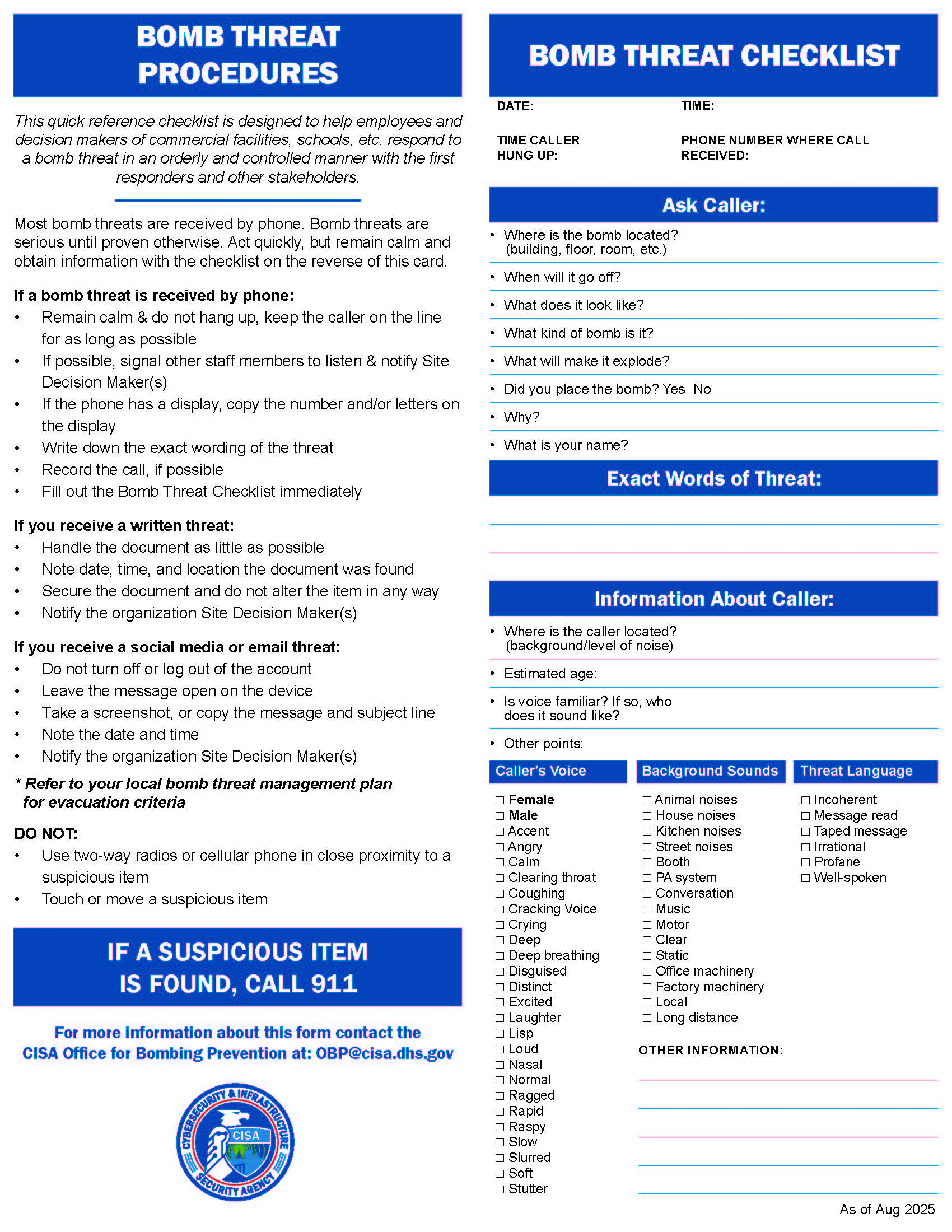
APPENDIX- Bomb or Explosive Threat- Code Blue-Quick Reference
Primary Rules
☐ Treat all bomb or explosive threats as real until proven otherwise by law enforcement.
☐ Do not touch, move, open, or disturb any suspicious item.
☐ Avoid cell phone or radio use near a suspected device or suspicious package location.
☐ Conduct visual searches only within your own area when directed and report any anomaly immediately.
Evacuation Considerations
☐ Evacuate only when ordered by administration or law enforcement.
☐ Avoid the suspected area and follow responder established routes if provided.
☐ Take rosters and emergency kits. Conduct roll call immediately at the rally point.
Bomb or explosive threats Calls-
Treat all bomb or explosive threats as real until proven otherwise. Stay calm, follow the chain of command, and execute this procedure immediately. Stay Calm and Listen
☐ Keep the caller on the line as long as possible. Be composed and courteous.
☐ Signal quietly to another staff member to call 911 and alert administration.
☐ Use the Bomb Threat Call Intake Form to capture details.
☐ Ask: What kind of bomb is it. Where is it located. When will it go off. Why was it placed.
☐ Record exact wording, time of call, duration, voice characteristics, and background sounds.
☐ After the call, avoid cell phones or radios near suspected areas.
Code Blue Announcement
☐ Announce: Code Blue. Staff implement bomb threat procedures. Do not use the word bomb publicly.
Visual Search Only
☐ Each employee visually searches their area right to left, floor to ceiling. Do not touch suspicious items.
☐ If found, move away, note location, and notify administration or responders.
Evacuation If Ordered
☐ Follow standard evacuation routes but avoid suspected areas. Bring rosters and emergency folders.
☐ Teachers conduct roll call. Report any unaccounted people to the Incident Commander.
☐ Only law enforcement or Bomb Squad may issue All Clear.
.
APPENDIX- Fire Response
Fire Safety and Extinguisher Use Quick Guidance
Evacuation
☐ Evacuate immediately when alarm sounds or when directed.
☐ Close doors and windows without locking.
☐ Move to assembly area and maintain clear lanes for responders.
Extinguishers
Use extinguishers only when you are trained, and the fire is small, contained, and you have a clear exit path.
| Step | Action |
| P | Pull the pin |
| A | Aim at the base of the fire |
| S | Squeeze the handle |
| S | Sweep side to side at the base |
☐ If smoke conditions worsen or the fire grows, evacuate immediately and close the door behind you.
Immediate Actions
☐ Activate Fire Alarm.
☐ Evacuate immediately using posted routes. Use alternate exits if blocked.
☐ Call 911 after evacuation.
☐ Assist injured or mobility impaired individuals.
☐ Close doors and windows. Do not lock.
☐ Do not collect personal items.
☐ Move 100 feet from building and stay clear of drives for emergency vehicles.
☐ Avoid smoke and stay calm.
Accountability
☐ Teachers take attendance using rosters.
☐ Display Green Card if all students are present. Display Red Card if missing students.
☐ Report unaccounted students to Principal or Assistant Principal immediately.
☐ Do not reenter until the All Clear is announced.
Assembly Areas
Primary Assembly Area: ECDC Parking Lot
Secondary: Playground
Environmental Disaster Contaminated Air or Water
Water Contamination
☐ Announce: Do not consume any water from facility sources.
☐ Provide bottled water or safe external supply.
Air Contamination Inside
☐ Initiate Fire Drill Evacuation Procedure.
Air Contamination Outside
☐ Shut down HVAC and remain indoors until directed.
Communication
☐ Call 911.
Tulsa Police: 918 596 9222
☐ Catholic Schools Office: 918 582 9177
☐ Superintendent David Dean: 901 626 4974
☐ Parents will be contacted via email and School Reach System
Nuclear or Chemical Contamination Disaster
Immediate Actions
☐ Initiate Tornado Drill Procedure to move to the lowest interior shelter.
☐ Shut off air handling systems as needed.
☐ Follow instructions from police and rescue personnel.
☐ Be prepared for extended shelter in place until safe transport is arranged.
Earthquake Response
During Shaking
☐ Command: EARTHQUAKE! TAKE COVER! DUCK AND HOLD!
☐ Students get under desks, cover heads, and hold until shaking stops.
☐ Expect alarms or sprinklers. Remain calm.
After Shaking Stops
☐ Evacuate using Fire Drill Routes to the Playground Safety Zone.
☐ Account for all students. Report injuries to administrators.
☐ If indoors, avoid glass and hanging fixtures.
☐ If outdoors, stay clear of trees, buildings, and power lines.
☐ If in vehicles, pull over safely and remain until shaking stops.
Federal Alignment and Operational Aids
This section provides practical job aids that support the Emergency Action Plan and reinforce consistent staff actions during real incidents.
Federal Reference Alignment Notes
The following federal resources are used as reference points to verify that action steps are identified, and that documentation supports readiness, response, and recovery.
| Agency | Reference | How It Is Reflected in CTK MARQ ECDC Forms |
| FEMA and US Department of Education | Guide for Developing High Quality School Emergency Operations Plans 2013 | Planning cycle, roles, reunification, training, drills, evaluation, and improvement planning are reflected in the evaluation, after action, and corrective action forms. |
| FEMA | National Preparedness Goal Mission Areas and Core Capabilities | Checklists and forms support response and recovery core capabilities including operational communications, mass care and reunification, situational assessment, and operational coordination. |
| DHS CISA | K 12 School Security Guide 3rd Edition and School Security Assessment Tool | Layered security and mitigation emphasis is supported through command roles, access control verification, perimeter coordination, and documentation of corrective actions. |
| FBI | Active Shooter Event Quick Reference Guide | Lockdown and last resort counter language aligns to life safety priorities and clear law enforcement coordination steps. |
| US Secret Service NTAC | Enhancing School Safety Using a Threat Assessment Model | Behavioral reporting, documentation, and pre-ident coordination are supported through incident documentation, reporting forms, and training records. |
| DHS CISA | Active Shooter Recovery Guide | Post incident actions, reunification control, communications, counseling coordination, and recovery documentation are captured in the recovery and after-action forms. |
APPENDIX – EVACUATION & STUDENT ACCOUNTABILITY PLAN
Parish of Christ the King & Marquette Catholic School
Aligned with OCCSAA, FEMA CPG 101, DOE/FERPA, and Diocese of Tulsa Standards
I. PURPOSE
To ensure safe, orderly, and documented evacuation procedures for all students, staff, and visitors during emergencies. This plan also establishes a standardized Student Accountability System to support reunification and communication.
II. COMMAND STRUCTURE
| Role | Responsibility | Contact |
| Incident Commander | Directs evacuation and coordinates with first responders | Principal / Assistant Principal |
| Director of Operations | Manages infrastructure and coordination | Chris Davenport – 918-584-4788 |
| Teachers / Aides | Lead evacuation and submit accountability forms | Per classroom |
| Office Staff | Handle emergency communications and parent notifications | 918-584-4631 |
| Custodial / Maintenance | Shut off utilities and assist responders | Maintenance Team |
| Nurse / First Aid | Operate First Aid Station and treat injuries | Health Office |
EVACUATION PROCEDURES
Activate alarm or announce via intercom: Attention: Evacuate the building. Follow evacuation routes. Confirm 911 call and notify Parish Office.
Teachers bring rosters, red/green cards, and emergency folders. Lead students to designated Safety Zone.
Conduct roll call upon arrival. Display Green Card (all accounted) or Red Card (missing/injured).
Submit Student Accountability Sheet to Check-In Table.
Set up Command Post, First Aid Station, and Parent Reunification area.
• Reunification occurs only after ID verification through RenWeb/FACTS and completion of the Reunification Log.
Complete this section as a form →APPENDIX- GENERAL EVACUATION PROCEDURES
Emergency procedures are in place to protect students and all school personnel from weather related and other problems. In case of an emergency evacuation of the school, parents/guardians, designated drivers have been asked to not immediately pick up their child from his/her teacher outside as this prevents us from getting an accurate record of everyone’s whereabouts. In the case of an evacuation, parents will be notified through our School Reach Phone System and through e-mail. Please do the following: Exit building as quickly as possible, following evacuation routes.
Bring paper for notes, pen/pencils and class roster. Check roll. Please do not count heads.
If you have any students unaccounted for, please write their names on paper and have a designated student take it immediately to the EVACUATION CENTER CHECK-IN LOCATION (Playground south of building).
Designated office staff (Evacuation Center Check-In Leads — currently Crissy Donatucci and Diane Hahn) will be responsible for this area and will need to bring paper, pen/pencil, plus a student and teacher schedule to this site to check out students to parents as they arrive at this location.
A pass will be issued to parents upon their checking in at the EVACUATION CENTER who in turn will give this to their child’s teacher, who then can release the child. Please be sure to mark a child on your roster as being picked up by parents so that we can have an accurate record of everyone’s whereabouts.
Parents will be notified about evacuation through an all-school e-mail or RenWeb Emergency Notification System phone call.
EVACUATION COMMAND POST SETUP
| Station | Function | Personnel |
| Check-In Table | Collects accountability sheets | Office Staff |
| First Aid / Treatment Area | Triage and minor medical response | Nurse / Admin Assistant |
| Parent Reunification | Verifies guardians and logs releases | Secretarial Team |
EVACUATION SITES
| Tier | Location | Use Case |
| Primary | Playground Safety Zone | General evacuation |
| Secondary | ECDC Parking Lot | Fire/Weather emergency |
| Tertiary | Society Lot (Across 15th Street) | Bomb threat/Structural hazard |
STUDENT ACCOUNTABILITY CHECKLIST
| Task | Responsible | Verified (☐) | Notes |
| Students evacuated via posted route | Teacher | ☐ | |
| Roll call completed | Teacher | ☐ | |
| Green/Red card displayed | Teacher | ☐ | |
| Missing/injured list submitted | Teacher | ☐ | |
| First Aid provided | Nurse/Admin | ☐ | |
| Students released only to authorized adults | Office Staff | ☐ | |
| 'All Clear' issued by authorities | Principal | ☐ | |
| After-Action Report filed | Admin/Director of Operations | ☐ |
APPENDIX- EVACUATION MAPS
Appendix A: Marquette ECDC Campus Evacuation Route and Assembly Point Map
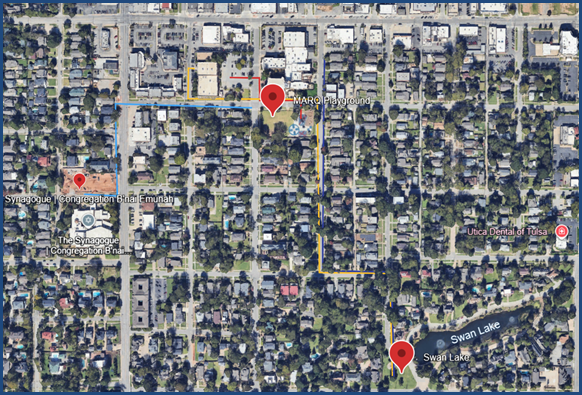
PARENT REUNIFICATION LOG
| Student Name | Teacher/Class | Parent/Guardian Name | ID Verified (☐) | Time Released / Staff Initials |
POST-EVACUATION REVIEW
Following every drill or real event, conduct an After-Action Review within 48 hours. Submit findings to the Risk Management Committee and retain documentation per Diocesan policy.
APPENDIX – Emergency Action Plan for Active Intruder / ALICE
Purpose
To provide clear, real-time procedures for all staff, parishioners, volunteers, and visitors at Christ the King Parish and Marquette Catholic School during an active intruder or violent threat. The goal is to save lives through situational awareness, rapid decision-making, and immediate protective action.
Situational Awareness
• Stay alert to unusual behavior, sounds, or disturbances.
• Trust your instincts — if something feels wrong, act immediately.
• Quickly identify your nearest exits, potential barricade materials, and communication options wherever you are.
• Always be aware of your environmental context — location of students, parishioners, open doors, and potential threats.
• Every second matter’s. Do not wait for confirmation of danger before acting to protect yourself or others.
ALICE Emergency Response Procedures
| Step | Action | Key Directives |
| A – Alert | Clearly communicate the threat immediately. | Use intercom, radio, or phone to announce the threat in plain language (e.g., 'Intruder in the main hallway'). If safe, call 911. Share details — location, description, direction of movement. |
| L – Lockdown | Secure your location. | Lock or barricade doors using desks, eyebolts, or furniture. Turn off lights, silence phones, and move out of sight from doors and windows. Stay quiet but alert for new information. |
| I – Inform | Keep communication open. | Relay real-time information to help others make decisions. Use radios, text alerts, or intercom if possible. Provide updates such as 'Intruder moving toward the gym.' |
| C – Counter | Distract and disrupt only if in immediate danger. | If an intruder breaches your area and escape is impossible, create confusion—throw objects, make noise, move quickly. Your goal is disruption, not confrontation. |
| E – Evacuate | Escape the danger zone if safe. | Leave immediately through any safe exit, even if it is not your usual route. Take others with you, but do not wait. Move to designated rally points and call 911 once safe. |
REMEMBER: You do not need permission to act. Protect life first. Property and order can be restored later. Stay calm, speak clearly, and lead those around you.
APPENDIX- Response by Location
CURRICULUM BREAKDOWN BY GRADE LEVELS
| Grade Level | Evacuate | Lockdown | Counter |
| K–3rd | Evacuate like a fire drill. Following teacher directions to rally point. | Remain quiet, follow directions, move away from doors/windows. | Not taught. Focus on listening and staying safe. |
| 4th–5th | Quickly and safely move to rally point via assigned routes. | Assist barricading doors; spread out, stay quiet. | Not taught. Focus on teacher direction. |
| 6th–8th | Know routes and rally points; practice scenarios. | Assist in barricading; use distraction techniques when necessary. | Introduce basic countering like noise/movement only under direction. |
CHURCH & CHAPEL ALICE RESPONSE
| Step | Action | Response Guidance |
| Alert | Recognize signs of danger (sounds, behavior). | Alert others and call 911 immediately. |
| Lockdown | Barricade doors if evacuation is unsafe. | Use available items to block entry; prepare to counter if breached. |
| Inform | Communicate intruder’s location and behavior. | Provide real-time updates to responders. |
| Counter | Distract and disorient. | Make noise, move, or throw objects to create an opportunity to escape. |
| Evacuate | Exit when safe. | Move to rally points like the ECDC building; stay out of line of sight. |
Classrooms / Offices:
• Lock or barricade doors.
• Turn off lights, silence all devices, move away from windows.
• Keep students calm and quiet.
• Prepare for evacuation if conditions change.
Hallways / Open Areas:
• Evacuate immediately if a clear path exists.
• If trapped, enter the nearest securable room and lockdown.
• Avoid large open areas unless escape is certain.
Church / Chapel / Gathering Spaces:
• Identify exits and move quickly to them if safe.
• If evacuation is not possible, move behind solid barriers (pews, altar base, sacristy areas).
• Use portable radios or phones to communicate intruder location.
• Encourage others to stay low, remain quiet, and follow your lead.
Outdoor Areas:
• Evacuate away from the threat to the farthest safe location.
• Move behind solid cover (buildings, trees, vehicles).
• Once safe, call 911 and report details.
If Law Enforcement Arrives
• Remain calm and follow all instructions.
• Keep hands visible and empty.
• Do not shout, run toward officers, or make sudden movements.
• Provide information about the intruder’s description, weapons, and location.
Post-Incident Actions
• Follow all directions from law enforcement.
• Report injuries or missing people to command staff immediately.
• Do not re-enter buildings until cleared.
• Provide emotional and physical support to students, staff, and parishioners.
Key Principles
• Situational Awareness Saves Lives- DO NOT ASSUME-Always know your surroundings.
• Decentralized Decision-Everyone has the authority to act.
• Dynamic Response -ALICE steps are not linear; use the safest option available.
• Calm Leadership -Fear is contagious; so is calm. Your tone and composure influence others’ survival.
APPENDIX- INTRUDER IN BUILDING
All strangers should be stopped and asked about his/her business in the building. Courteously direct anyone you do not know to the main office to check in.
If he/she refuses or is hostile, do not argue. Notify office staff at once. The principal and assistant principal will be contacted. Do not engage anyone who appears hostile. Do everything to protect yourself and students.
As determined by administrator and office staff, Police (911) will be contacted.
If a stranger is deemed a threat, an INTRUDER IN BUILDING/LOCK DOWN will be announced where teachers and students are to lock themselves in rooms until given the all-clear signal, which will be INTRUDER IN BUILDING/LOCKDOWN CANCELLATION.
Employees other than administration may indicate a lockdown if the situation is serious. Employees have permission to initiate the process without seeking administrative approval first. Please notify the office immediately of a situation that would warrant a lockdown.
A LOCKDOWN IS A RESPONSE TO A THREAT THAT IS OUTSIDE THE BUILDING. AN INTRUDER ON CAMPUS IS INTERPRETED AS SOMEONE INSIDE THE BUILDING OR ACTIVELY TRYING TO GET IN.
If the threat is OUTSIDE on the campus property or outside the buildings, all exterior doors should be locked, shades pulled, and everyone needs to stay away from windows. Depending on how serious the threat may be, lock classroom doors, shelter in the room, and turning out the lights may be necessary. The point is to keep the threat outside and keep an assailant from getting into the building or harming anyone through a window or opening.
If the threat is INSIDE, the process is different. We leave curtains or blinds open if the threat is inside, so emergency responders can see into the building and see if the threat is standing in a particular room, so escape is possible.
In “Lock-Down:”
911 will be called
CLEAR HALLS of all students. Please bring any students in the hall near your room into your class whether they are part of your official class or not. Make a list of these students and their regularly assigned teacher/classroom and tape to window of door. Include any missing children from your classroom on that list and delineate between the two.
Place a pre-designated colored card outside your classroom door on the floor – Green for everyone who is accounted for and safe or Red for a child who is missing or hurt. If a card is not placed outside your door, administration and law enforcement will assume that an intruder is in your classroom.
Lock doors, turn off lights, close windows/shades, move students away from doors/windows. Barricade the door with any heavy object or furniture if the door cannot be secured. Silence cell phones.
Inform your students in a calm way that a “lockdown” is underway and explain what it means.
When the police arrive, they oversee the situation.
LOCKDOWN EVACUATION PROCEDURES
Building Signal is given to begin Lock Down; Lock Down Occurs
DURING SOME LOCK DOWNS, AN EVACUATION MAY BE NECESSARY.
A law enforcement official (usually a Tulsa Police Officer) will come to your classroom to initiate the evacuation.
Evacuate only if you are instructed to do so by a law enforcement official. The law enforcement official will provide specific instructions to conduct the evacuation. Follow all of these instructions carefully. Assist the official with communications with your class and with ensuring that students understand the instructions that are given.
Follow the evacuation route established by the Police. This may or may not be the Fire Drill Evacuation route of your classroom.
Take your gradebook. When you arrive at the post-evacuation point, keep your class together.
Further instructions will be provided as soon as possible. Wait and reassure students. REMEMBER that police officials are dealing with a very volatile situation and may have to ask questions or, in some cases, double-check to ensure that no perpetrator is with your group masquerading as a student/teacher in order to escape.
Departure from the school site MAY be necessary. If this occurs, the Evacuation Site for our school will be used wherever possible.
DO NOT DISMISS ANY STUDENT UNTIL THE OFFICIAL WORD IS GIVEN TO DO SO.
For a “Modified Lock – Down:”
All exterior doors will be locked, and no persons will be allowed in or out, unless cleared by the principal, assistant principal or designee.
School will continue to function as close to normal as possible INSIDE in the building.
All clear will be an intercom announcement “LOCKDOWN CANCELLATION.”
Courteously ask the person if they need to be directed to the office. If they say “no,” and remain near the kids or pose a threat, bring students to the room immediately and notify principal and assistant principal and office staff about the situation. Do not engage anyone who appears hostile. Do everything to protect yourself and students.
As determined by administration and office staff, police will be called, and all exterior doors will remain locked. No one will be allowed in or out unless cleared by the administration.
School will continue to function as closely to normal as possible in the building. All clear will be an intercom announcement “LOCK DOWN CANCELLATION.”
APPENDIX- GUN OR WEAPON IN SCHOOL OR CLASSROOM
GUN SUSPECTED IN CLASSROOM
Do not leave the room.
Ask a neighboring teacher to come to your door.
CONFIDENTIALLY tell the colleague that you suspect a student has a gun/weapon in class. Give the name/seat location of the student who is suspected.
Tell the colleague to inform the office IMMEDIATELY.
Continue class and the lesson. Administration and Police will arrive promptly.
GUN PULLED OR DISPLAYED
If a student/intruder pulls a gun in class, DO NOT try to disarm the individual.
Remain calm. Tell the rest of the class to remain seated and to stay calm.
STAY AWAY from the student with the gun. Talk to the student in as controlled a manner as possible.
ASK THE STUDENT TO PUT THE GUN DOWN AND MOVE AWAY FROM IT.
Do what you can to get the attention of another colleague, and the office so help can be summoned.
GUN IN A LOCKER OR GUN ON A STUDENT IN THE HALL
If you see a gun on a student in the hall, follow the student. DO NOT LET THE STUDENT OUT OF YOUR SIGHT.
If the gun is in a locker, DO NOT LEAVE THAT LOCKER.
Contact an administrator or ask a colleague to make contact with you.
Wait for assistance. DO NOT LEAVE THE STUDENT OR THE LOCKER.
GENERAL GUIDELINES FOR ANY GUN CRISIS
Tell an administrator any time you hear that a gun or weapon may be present in school.
DO NOT send a student to report on the presence of a gun/weapon. Enlist the help of an ADULT to do this.
TAKE ALL TALK OF GUNS OR IMPENDING USE OF GUNS IN SCHOOL OR SCHOOL EVENTS SERIOUSLY. TELL THE OFFICE!
SCHOOL ACTIONS
CONDUCT AN IMMEDIATE LOCKDOWN.
Contact 911 and Tulsa Police 918-596-9222
Respond to the classroom/location
HOSTAGES TAKEN IN CLASSROOM OR AT SCHOOL
IF YOU OBSERVE A HOSTAGE CRISIS UNDERWAY:
DO NOT intervene.
Quietly remove yourself from the setting.
ALERT SCHOOL ADMINISTRATION IMMEDIATELY.
If you do have a class or other obligation with students, remain out of sight but stay in proximity to the hostage area so you can prevent others from wandering into the situation.
When the LOCK DOWN Code is given, remove yourself from the area and participate in the Lock Down.
IF A HOSTAGE SITUATION OCCURS IN YOUR CLASSROOM OR SUPERVISION AREA:
Remain calm. Avoid quick movements.
FOLLOW THE INSTRUCTIONS OF THE HOSTAGE TAKER.
Tell your students to follow these instructions.
DO NOT try to disarm the hostage taker.
DO NOT bargain or negotiate with the hostage taker.
If you need to speak to the hostage taker, ask permission to do so. (Face the hostage taker when speaking. Do not crowd his/her space. Be respectful. NEVER criticize the hostage taker. DO NOT argue).
Make mental lists of:
Students were absent from class that day.
A chronology of what happens during the crisis.
Police negotiators will make contact! TRUST THEM COMPLETELY AND FOLLOW THEIR INSTRUCTIONS TO THE LETTER.
STAY ALERT. Attempt to evacuate students ONLY if the hostage taker falls asleep.
SCHOOL ACTIONS:
CONDUCT AN IMMEDIATE LOCKDOWN
CONTACT “911” AND TULSA POLICE – 918-596-9222.
APPENDIX- FIELD TRIP: EMERGENCY OR CRISIS
On each field trip, a total of three (3) lists should be created for all students, volunteers, parents, and employees attending the event.
One list is to be retained at the school office.
One list is to be submitted to the Command Post or the investigating police officer on the scene.
One list is to be retained by the employee in charge of the field trip
ACCIDENT WHILE ON A FIELD TRIP:
Work with the private car/bus driver to evacuate the car/bus if necessary. If evacuation is NOT required, wait with students in the car/bus until emergency workers/police arrive.
If there is a danger of fire or explosion, evacuate the car/bus immediately. Work with private car driver/bus drivers to communicate with the Police Department. Request emergency assistance.
Report on location.
Report injuries; if possible, indicate names of students.
Ask for the Police to contact our school.
Keep lists:
Injured students; be sure to record the hospital to which students are taken if this is required.
Note a chronology of what happens; if possible, jot a sequence of events that occur.
Let Police and Emergency workers deal with the driver of the other vehicle.
DO NOT comment to media representatives; refer inquiries to either the Principal of Marquette, the Assistant Principal or a Marquette Public Relations representative.
Prepare to write up a narrative of what happened and submit it to the building administrator.
APPENDIX – Emergency Action Plan for Medical Situations
DEATH OF A STUDENT OR STAFF MEMBER
In the event of a death of student/staff:
Contact principal (918-510-7299), assistant principal (918-520-6505) who will notify Father Elkin, the Assistant Principal (918-520-6505) and Superintendent of Catholic Schools, David Dean (1-901-626-4974).
Notify staff through FACTS or individual phone calls and set up meeting times for discussion.
Be sure every faculty member is informed of the incident and response plan.
Share facts surrounding the incident so that rumors can be dispelled.
Death of a student/staff member AWAY from school:
Develop crisis plans to address the level of need.
The principal, along with Father Elkin, and the Assistant Principal, shall determine when a home visit should be made.
Student/staff who appear extremely upset need to be counseled on a one-to-one basis if possible.
A staff meeting at the end of the day will be held at debrief events and share any additional information.
Death of student/staff member AT school:
Notify the principal, call 911 immediately. the Pastor (Fr. Elkin) and the Assistant Principal will also be notified. Family members will be contacted.
The area immediately surrounding the individual must be secured and closed off, making sure that nothing is touched, moved, or removed while waiting for authorities.
If in a classroom, other students are directed to another room.
If in a hallway, lobby, common areas, or outside, the area immediately surrounding is blocked off and students are directed away from the scene
All media contacts should be referred to the principal, assistant principal, or his/her assigned.
The principal will set up a faculty meeting as soon as possible.
Parents would be notified through a text message or phone call.
APPENDIX- ACCIDENT/SERIOUS INJURY/ILLNESS
An unexpected serious occurrence demanding immediate action to aid the injured/ill person(s)
The situation should be assessed for personal risk factors prior to assistance/intervention.
Gloves MUST be worn if blood is present. Gloves are available in the office.
Do not move or allow movement of anyone injured.
In case of serious injury/illness, notify the Principal (Jay Luetkemeyer) (918-510-7299) or the Assistant Principal (Tracey Robinson, 918-520-6505).
Seek first aid immediately. If a student, contact parents at once.
Notify 911 if the injury or illness seems serious enough to warrant transport to the hospital.
Notify Father Elkin.
Have follow-up meetings to assess the need for additional information to be sent to other groups in the school community.
APPENDIX- CODE BLUE — BOMB / EXPLOSIVE THREAT QUICK REFERENCE & CHECKLIST
Christ the King Parish & Marquette Catholic School / ECDC
Treat all bomb or explosive threats as real until proven otherwise.
Stay calm, follow chain-of-command, and execute this procedure immediately.
PURPOSE
To provide staff with immediate, actionable guidance in the event of a bomb or explosive threat, ensuring safety, proper communication, and rapid coordination with law enforcement. All personnel must remain calm and treat every threat as credible until verified by the Bomb Squad or Police.
1. STAY CALM AND LISTEN
• Stay composed and courteous. Keep the caller on the line as long as possible.
• Signal quietly to another staff member to call 911 and alert the administration.
• Use the Bomb Threat Checklist (Attachment A) to capture all details.
• Ask the caller (without provoking them):
• What kind of bomb is it?
• Where is it located?
• When will it go off?
• Why was it placed?
• Record the caller’s name (if given), voice tone, age, accent, background sound, and exact wording.
• Write down the time of the call and duration.
• If you can safely record or trace the call, do so.
• After the call, do not use cell phones or radios near suspected areas.
• Immediately notify the Principal / Assistant Principal / Director of Operations.
2. CODE BLUE ANNOUNCEMENT
• Over the PA system, announce: “CODE BLUE”. Staff: implement bomb threat procedures.” (Do not use the word ‘bomb’ publicly.)
• Ensure the office notifies Principal, Assistant Principal, and Maintenance.
• All staff remain calm and await further instructions.
• Avoid using radios or walkie-talkies near potential devices.
3. NOTIFY LEADERSHIP
Command Chain:
| Principal | Incident Commander / Contact Police |
| Assistant Principal | Coordinates classroom and office response |
| Director of Operations (Chris Davenport) | Facilities, maintenance, perimeter, responder coordination |
| Office Staff | Manage communications, record information, assist responders |
| Maintenance/Custodial | Conduct physical visual searches (do not touch) |
Staff -Responders will:
• Notify 911 immediately and request Bomb Squad and Police presence.
• Establish a command post away from potential threat areas.
• Determine whether to evacuate or shelter-in-place-Comply with Law enforcement
4. SEARCH YOUR AREA (VISUAL ONLY)
• Upon hearing “CODE BLUE,” each employee searches their own area for anything unusual.
• Search right-to-left, floor-to-ceiling, checking under desks, behind furniture, inside closets, and under tables.
• DO NOT TOUCH or move any suspicious items.
• If found, move away immediately, note the location, and notify administration or first responders.
• Maintenance/Custodial check restrooms, trashcans, mechanical rooms, and exterior grounds.
• Food Service inspects kitchen and storage areas.
• Teachers ensure students stay calm and remain seated unless directed to evacuate.
5. EVACUATION (IF ORDERED)
• Follow standard fire drill routes but avoid the suspected area.
• Take class rosters and emergency kits to designated rally points.
• Teachers conduct immediate roll call upon arrival.
• Report all unaccounted people to the Principal, Assistant Principal, or Director of Operations.
• Keep hallways, driveways, and entrances clear for emergency responders.
• Await official “All Clear” before reentry.
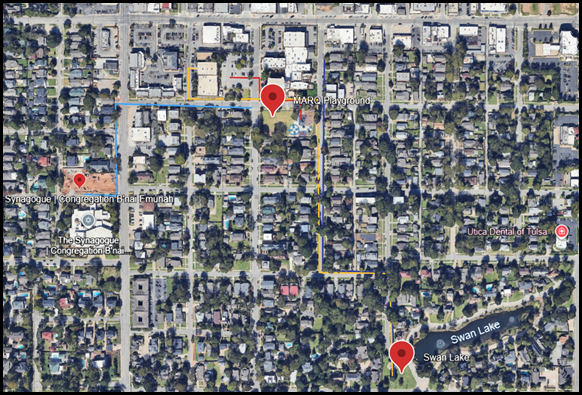
6. COMMUNICATION
Internal:
• Use landlines located away from suspected areas.
• Avoid cell phone use near suspicious packages.
• Limit hallway movement — communicate through supervisors only.
External:
• Only administration or police release public statements.
• The Communications Officer (if designated) will issue controlled messages to parents and media.
• Maintain discretion to prevent panic or misinformation.
7. ALL CLEAR / RETURN
• Only law enforcement or the Bomb Squad may issue an All Clear.
• Principal or Director of Operations will announce via PA when safe to return.
• After the event, conduct debrief with staff and complete After-Action Report.
• File all Bomb Threat Checklists and Incident Forms for recordkeeping.
ATTACHMENT: CONTACT DIRECTORY
| Emergency Service (Police/Fire/EMS) | 911 |
| Marquette Main Office | 918-584-4631 |
| ECDC Office | 918-583-3334 |
| Parish Office | 918-584-4788 |
| Director of Operations – Chris Davenport | On-Site / Radio / Mobile |
| Tulsa Police (Non-Emergency) | 918-596-9222 |
| Tulsa Fire (Non-Emergency) | 918-596-9977 |
FIELD REMINDERS
✔ Do not use radios or phones near suspicious devices.
✔ Never move or open suspicious packages.
✔ Do not re-enter the building until instructed by law enforcement.
✔ Keep this sheet posted near phones, intercoms, and offices.
✔ Conduct annual drills and review procedures every semester.
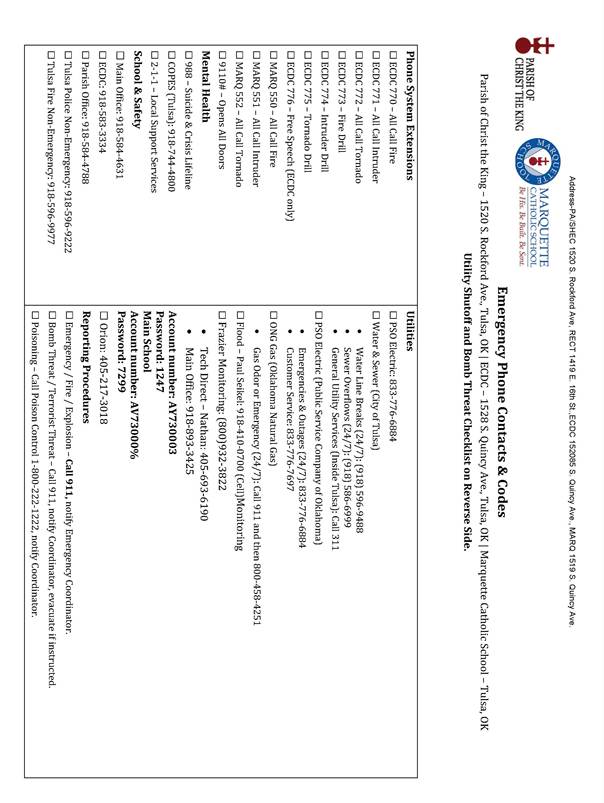
APPENDIX – Emergency Action Plan for Domestic Violence / Civil Disturbance
REPORTING CHILD ABUSE
Oklahoma requires teachers, nurses, and all other school personnel to promptly report any suspected cases of physical abuse, sexual abuse, exploitation, or neglect of a child. Failure to report such information promptly, false reports, or reporting with lack of factual foundation, is a misdemeanor. The law also grants immunity from civil or criminal liability to a person who in good faith makes such a report. It is not the responsibility of school personnel to prove the child has been abused or neglected.
Any suspected case of child abuse must be reported to the principal or assistant principal.
If the evidence appears to confirm the suspicion, immediately phone (918-581-2401) the child abuse office of the Oklahoma Department of Human Services – there should be no delay in reporting. Father Elkin Gonzalez and Superintendent of Catholic Schools, David Dean, will be contacted.
The principal will complete a “Child Abuse Report” and it will be signed by the principal, and any other staff member involved.
Appropriately identified investigators of the Department of Human Services of the District Attorney’s Office will be permitted access to a student involved in suspected child abuse.
The principal/assistant principal will arrange the interview in a manner that minimizes embarrassment to the child.
The principal/assistant principal or designated employees WILL BE PRESENT DURING THE INTERVIEW.
APPENDIX- INDICATORS OF PHYSICAL ABUSE
One or more of these indicators, or if they are happening in a pattern, could be a possibility of abuse.
PHYSICAL INDICATORS -
Questionable bruises or welts:
On the face, lips, mouth, torso, back, bottom, or thighs.
Human bite marks.
Reflecting the shape of the article used to inflict (fly swatter, belt, electric cord).
In various stages of healing.
Marks are often new after a weekend, or absence
Bruises on several of the questionable surface areas.
BURNS - Questionable burns
Cigarettes burn particularly the bottom, back, and palms of hands.
Immersion burns (sock-like or glove-like) doughnut-shaped on the bottom or genitalia). This is seen a lot during potty training when a child has an accident.
Patterns like a rope burn or from an iron.
FRACTURES – Questionable fractures
To the skull, nose, or face
Multiple fractures in different stages of healing.
CHILD BEHAVIORAL INDICATORS
I don’t want to go home.
Wear extra clothes regardless of the weather.
Afraid of parents.
Behavioral extremes: aggressiveness or withdrawal.
Arrives at school late or stay after school to avoid going home.
Complaints of soreness and moves uncomfortably.
Run away (older children).
Reports abuse or injury by parent or caretaker.
APPENDIX- INDICATORS OF EMOTIONAL MALTREATMENT
One or more of these indicators could be a possibility of abuse.
PHYSICAL INDICATORS:
Speech disorders
Lags in physical development
Failure to thrive (a condition where the child has failed to gain weight expected for normal growth).
Ulcers, asthma, severe allergies CHILD BEHAVIORAL INDICATORS
Habit disorders (rocking, thumb sucking and biting – in an older child)
Behavioral extremes: passive and compliant or aggressive and full of rage.
Developmental lags
Self-destructive, attempted suicide
CARETAKER CHARACTERISTICS:
Withholds love
Blames or belittles the child
Rejects the child
Seems unconcerned about the child
INDICATORS OF NEGLECT
One or more of these indicators could represent a pattern.
Low self-esteem and very poor social skills
Child is often hungry and will eat just about anything
Poor expressive language skills
Overly complaint
Anti-social behavior
Parents are never around or available
Clothes are worn repeatedly and are very dirty along with the child’s physical appearance (dirty face, skin, hair)
APPENDIX- INDICATORS OF SEXUAL ABUSE
One or more of these indicators, or if they are happening in a pattern, could be a possibility of abuse.
PHYSICAL INDICATORS:
Difficulty in sitting down or walking
Genital or rectal problems – itching or pain in these areas. Blood in the underwear, problems going to the bathroom. A young child might say “it hurts down there” while pointing to the genital area.
Frequent urinary or yeast infections
Venereal disease or pregnancy especially in pre-teenagers
CHILD BEHAVIORAL INDICATORS
Re-enactment of the events. Children often act out in play situations what they are unable to express verbally.
Unusual or bizarre sex themes in their play or art
Reluctance to undress in front of anyone
Sleep problems
Unusual absences
Precocious sexual knowledge. The child’s vocabulary might include sexual words not used by other children.
Unusual interest in sexual matters.
Regression in toilet use, speech patterns, bed-wetting, and other areas in which they once had mastered.
Indirect hints about “mommy or daddy’s new friend” or a houseguest.
Revelation. The child might say something like “my brother wouldn’t let me go to sleep last night” or “my babysitter keeps bothering me.”
Remember that some children show no signs and with the exception of the child reporting the incident, all these behaviors may indicate problems not related to sexual abuse.
CARETAKER CHARACTERISTICS
The non-abusing caretaker is frequently out of the house, which permits the perpetrator access to the child
Abuser was abused as a child and has never learned what is appropriate
Encourages children to engage in sexual acts or pornography in front of the caretaker.
APPENDIX- STUDENT RUNAWAY/ABDUCTION
MISSING ON CAMPUS – Student has not been seen on campus and parents are reporting the child is supposed to be at school.
SEEN LEAVING CAMPUS OR RUNAWAY – Contact parents and determine with their consultation if police are needed. An employee may be designated to follow a student seen leaving the campus.
ABDUCTED CHILD – In this circumstance, the person who has observed the abduction or the person reporting must call 911 immediately. Abductions by STRANGERS have a documented rate of murder of the child on average within the first 30 minutes of abduction. The response in these cases from police is immediate and aggressive, with every officer involved in that is on duty. In observing an abduction, please report this information to the office after calling 911. Time is of essence. Do not engage the abductor. Follow at a discreet and safe distance.
When it has been determined that a student is missing, seen leaving campus or abducted and a search has no results:
Notify principal or assistant principal
Contact parents/guardian
Contact security or police (911) as needed.
Obtain pictures of children for authorities.
Describe clothing worn when a student was last seen.
Notify classroom teachers and other faculty members.
Contact the Pastor (Fr. Elkin).
Contact Superintendent of Catholic Schools, David Dean.
Have follow-up meeting to assess need for additional information to be sent to other groups in the school community,
All media contacts should be referred to the principal, assistant principal, or assigned.
APPENDIX- STUDENT ENDANGERMENT/VIOLENCE
In the event a student or employee actively attempts suicide, 911 and police should be called as they have demonstrated under law; they are a danger to themselves and could be considered a danger to others. In some circumstances, police may be the agency deemed most appropriate to transport a suicidal person to a treatment facility.
Student endangerment may take on many forms. Basic guidelines to be used as needed in each situation include:
Call principal, assistant principal or office for assistance.
Take measures to protect other students and self.
Speak in a calm manner – DO NOT escalate.
If a weapon is involved, DO NOT struggle to obtain a weapon.
Call 911.
Document in writing for principal files.
Notify parents.
APPENDIX- SUICIDE INTERVENTION
If an employee has reasons to believe a student/staff member is in danger of harming him/herself, the employee is to report the situation immediately to the principal or assistant principal.
The principal will:
Contact the parent if it is a child.
Contact spouse or applicable family member if it is a staff person.
Contact the Pastor (Fr. Elkin).
Contact Superintendent of Catholic Schools, David Dean (1-901-626-4974).
If the individual is exhibiting active suicidal thoughts, talks about committing suicide, or appears to have a plan:
Do not leave the person alone.
Do not allow the individual to go home unsupervised.
Provide phone numbers of local agencies to parents/guardian/spouse/family members.
LOCAL CONTACT AGENCIES
Refer to the approved provider list in the principal’s office and in this manual.
If emergency call:
Police…911
Ambulance…911
Poison Control…1-800-222-1222
A student who has threatened to harm him/herself or others will not be allowed to return to school until an evaluation of his/her condition has taken place with a mental health expert at parent’s expense. A written report by the mental health expert must be given to
The principal or assistant principal along with a phone call from such a person before a student may return to school.
APPENDIX- DEATH BY SUICIDE
If death was a suicide, post-venation procedures outlined by the American Association of Suicidology (AAS) should be followed. The tasks of post-venation are twofold:
To reduce the chances of anyone else dying by suicide by avoiding glamorization of the deceased.
To assist staff and students with the grieving process.
PROCEDURES:
Call 911 – Contact Principal Cell (918-510-7299), Assistant Principal, Tracey Robinson (home 918-252-4767; Cell – 918-520-6505) and the Superintendent of Catholic Schools, David Dean, (Work 918-582-9177; Cell- 1-901-626-4974).
Notify parents if they are children in school. Notify spouse or other family members if an employee.
Coordinate with law enforcement and let them take control of the scene if death occurs on-site.
Secure the area. The area immediately surrounding the individual must be secured and closed off. NOTHING IS TO BE TOUCHED, MOVED, OR REMOVED WHILE WAITING FOR AUTHORITIES.
If in a classroom, direct students to another room.
If in a hallway, lobby, commons area, or outside, the area immediately surrounding is blocked off and students/staff are directed away from this area.
Notify parent and school community through School Reach Phone System and via e-mail as warranted.
All media contacts should be referred to the Principal, Assistant Principal, or Designee.
The principal will set a faculty meeting as soon as possible.
Begin Crisis Response as established (Call counselors, approved counselors — Chuck McGowen, Donna Boswell, Faith Boudreau, and Mark Sadler for emotional support for staff and students).
Inquire about clean-up from police or fire departments.
Conduct a follow-up meeting with staff to assess what needs to be done next.
OTHER GUIDELINES
DO Not dismiss school or encourage funeral attendance during school hours.
DO NOT dedicate a memorial to the deceased.
DO NOT have a large school assembly.
Do give facts to students.
Do emphasize prevention and everyone’s role in protecting each other.
Do provide individual and group counseling.
Do emphasize that no one is to blame for suicide.
Do emphasize that help is available and that there are alternatives to suicide.
APPENDIX – Emergency Action Plan for Business Continuity, Cybersecurity & Data Protection
Parish of Christ the King & Marquette Catholic School
Emergency Operations Restoration – Required Data and Documentation
The following list outlines the critical documents, data, and resources needed to restore operations in the event of an emergency. This includes systems, infrastructure, personnel, and communication requirements necessary to resume essential parish and school functions.
1. Administrative and Leadership Records
Organizational chart with leadership contacts and emergency authority.
Parish and school emergency contact directory (including Diocese, Police, Fire, EMS).
Facility access to authorization lists and building keys or digital credentials.
Employee rosters, volunteer lists, and critical role assignments.
Insurance policies and claims contact information.
2. IT Systems and Data
Full IT asset inventory (servers, endpoints, network switches, cameras, etc.).
Backup schedules, encryption keys, and off-site/cloud storage locations.
System passwords and access recovery documentation (stored securely).
Software license keys, vendor support agreements, and configurations.
Network topology maps and firewall/router configurations.
3. Financial and Operational Records
QuickBooks and financial backup files (including parish, ECDC, and Marquette).
Payroll data and employee direct deposit configurations.
Tuition, donation, and accounts for receivable data exports.
Vendor contracts and purchasing records for ongoing operations.
Budget and insurance documentation for reimbursement and recovery.
4. Facilities and Infrastructure
Building blueprints, site maps, and utility schematics (electrical, water, gas).
List of essential equipment and vendors for HVAC, electrical, plumbing, and security.
Maintenance and inspection logs for fire alarms, sprinklers, and generators.
Access control and surveillance camera layouts (Genetec, Axis, etc.).
Location of emergency supplies and safety equipment.
5. Communication and Public Information
Mass notification system credentials (email, text, phone).
Templates for public announcements to families and parishioners.
Crisis communication chain and designated spokespersons.
Alternate communication methods if power/internet is unavailable.
Parish and school websites and social media access credentials.
6. Business Continuity and Recovery
Documented Recovery Time Objective (RTO) and Recovery Point Objective (RPO) for systems.
Alternate worksite or remote operations plan for staff and teachers.
Critical vendor dependencies and continuity assurances.
Incident logs and previous recovery test results.
Checklist for post-incident review and lessons learned documentation.
All documents should be stored securely in both digital and physical form. Digital copies must be encrypted and backed up off-site or in the cloud. Physical binders should be kept in secure yet accessible locations such as the Parish Office, Marquette Administration, and the Rectory. Annual reviews are required to ensure accuracy and compliance.
APPENDIX – Emergency Action Plan for Subpoena / Law Enforcement
MEDIA RELATIONS
News departments monitor police, fire, and ambulance radio dispatch scanners. Therefore, reporters are aware of most emergency calls and often arrive on the scene very quickly or telephone for immediate information.
In case the news media shows up, please contact the principal or assistant principal. They in turn will apprise Father Elkin Gonzalez and Superintendent, David Dean, of the situation.
The Principal (Jay Luetkemeyer) is the designated school spokesperson with the media unless someone else is designated.
Be accessible-be prepared, be honest-be brief-stick to the facts and do not give your opinion-stress to student safety.
Designate an area for media, both inside/outside buildings.
Know what is being done to help students and staff cope with the situation.
Confidentiality must be maintained to protect students’ rights.
Never say “No comment.” Instead say, “I will have to get back to you.”
If you don’t know the answer, say, “I don’t know, but will find out.”
Remember, few things are ever “off the record,” and the interview is not over until the reporter leaves.
Sample Crisis Media Release:
“Thank you for your concerns. Our staff is assessing the situation currently.”
Appendix- Health EAP
HEAT SAFETY TIPS FOR SCHOOLS
As classes begin during the hottest part of the year, the Oklahoma State Department of Health offers the following guidelines to help parents, teachers and school administrators be aware of heat-related illnesses and other safety concerns. The extreme temperatures that Oklahoma experiences mean that adults should be even more cautious than usual when it comes to hydration needs for students, as well as a range of other concerns such as hot playground equipment that could cause burns.
HYDRATION:
Ensure that students are well hydrated and have access to cool and shady areas to cool off.
Provide access to plenty of cool water as the liquid of choice.
Encourage students to drink water, even when they are not thirsty.
CLOTHING:
Encourage students to wear loose-fitting, lightweight, light-colored summer clothing.
BUSES – Refers to field trips
Consider stocking school buses with heat illness emergency kits including ice chests with ice, bottled water and wet towels.
Try to limit time children spend outdoors waiting for buses, or inside a parked school bus that has not cooled down during the loading process.
OUTDOOR
Consider modification of practice schedules for athletics and other events.
Avoid utilizing playground equipment that may become very hot at extreme temperatures.
Move outdoor activities indoors when feasible to a cooler area.
STAYING COOL
To prevent heat fatigue, offer regularly scheduled rest periods
Indoor temperatures can sometimes exceed the outdoor temperature, especially if there is no air conditioning or if air conditioning is not working properly. To assist in keeping the classroom temperature comfortable, keep windows and doors open with at least one fan moving air throughout the room.
Allow students to utilize alternative areas that may be cooler, such as those located on the lower or ground level of the school or shady areas on the school grounds.
Consider relocation of classes if air conditioning is not functioning properly.
RECOGNITION OF HEAT ILLNESS:
Encourage students to tell teachers if they feel ill.
Be aware of these heat stress symptoms:
Muscle spasms and cramps.
Skin is flushed, or cool and pale.
Headaches, dizziness, and nausea.
Rapid pulse rate.
Shallow breathing.
Elevated body temperature (in cases of heat stroke, body temperature can be very high, sometimes as high as 105 degrees F).
The sensation of sweat.
Loss of consciousness.
TREATMENT OF HEAT-RELATED ILLNESSES
Move the person to a cooler place to rest in a comfortable position.
Replenish fluids – Give person small amounts (4-5 ounces) of water every 15 minutes.
Make sure the person drinks slowly.
Loosen tight clothing.
Apply wet clothes or immerse yourself in a cool bath.
Immediately call 911 if the person loses consciousness.
Marquette has contacted TPS to notify our school in the event of a lightning threat. If there is a lightning threat, outside events will be postponed or cancelled. If during the end of the day dismissal, students and adult personnel will remain inside and parents must come in the building to pick up their children. If it occurs at dismissal, the following will take place.
Grades 6-8 will be dismissed at back doors facing Rockford. Grades 3-5 will be dismissed from the main door.
Grades K-2 will be dismissed from kindergarten doors facing the guard shack.
*Older students will go to the location of the youngest sibling.
APPENDIX- EMERGENCY PROCEDURES -ACCIDENTS/ILLNESS/MEDICATION
If a student incurs injury as the result of an accident, please complete an ACCIDENT REPORT FORM.
Personnel assisting students with open wounds or who have vomited are asked to wear rubber gloves.
Medications may be dispensed only by authorized personnel and only if written parent authorization is on file. STUDENTS ARE NOT ALLOWED TO CARRY MEDICATION.
All new teachers are encouraged to have current CPR training. Veteran teachers need updated training every five years. Marquette is responsible for emergency handling of accidents/sudden illness occurring at school and during school-sponsored activities.
In case of accidents or injuries please adhere to the following:
Give students immediate and temporary first aid care, if necessary, to preserve life, to prevent dangerous loss of blood, or to prevent other such emergencies. When treating a wound of any kind, personnel must use gloves. If there is spurting blood or vomiting, goggles and rubber masks should be worn.
Notify administration and child parent/guardian. In all cases where it is possible to do so, wait for instructions from parent/guardian before proceeding. The school’s right to give treatment goes no further than immediate first aid, which will protect the life of the individual until additional treatment is secured.
The school should have student emergency information, delegating the school the right to contact others besides parent/guardian in case they cannot be reached. Family physicians will be called.
Ordinarily, School personnel should not transport seriously injured/ill student unless there is an emergency need to do so. If parents cannot provide transportation to medical treatment, ambulances should be called.
If a child remains seriously injured/ill at the end of the school day, he/she shall not be allowed to go home unless accompanied by parent/guardian. No child shall be allowed to leave School during regular school hours unaccompanied by a parent/guardian/parent delegate unless written request has been received.
After a serious accident or emergency illness, a record of the incident and procedures taken must be made and filed.
School reserves the right to act as deemed necessary by the principal or designee in a life-threatening illness.
Unclaimed or unused medications at the end of the year will be given back to parents. If a student leaves before the school year ends, unclaimed or unused medications will be given to their parents. If parents don’t respond, the medication will be disposed of in the proper manner. Schedule I drugs will be surrendered to law enforcement for disposal or destruction.
If lightning occurs while an outdoor event is being held, all students and adults will be brought inside immediately.
APPENDIX- EMERGENCY TEACHERS REPORT – MARQUETTE CATHOLIC SCHOOL
Date:Teacher & Room
Roster of Students:
1.
2.
3.
4.
5.
6.
7.
8.
9.
10.
11.
12.
13.
14.
15.
16.
17.
18.
19.
20.
21.
22.
23.
24.
DISASTER DRILL ROOM REPORT
Children Absent (From School) Children Injured (Left in Room)
Children Not Accounted For Children Injured (Sent to First Aid Center)
APPENDIX- SEND TO EMERGENCY OPERATIONS CENTER (EOC)
Indicate a check mark for those students who have been picked up.